
A campus instructor asks which headers wrap application data as it moves down the stack for transmission. Which sequence is the one this exam uses?
Select an answer to reveal the explanation.
Short Explanation
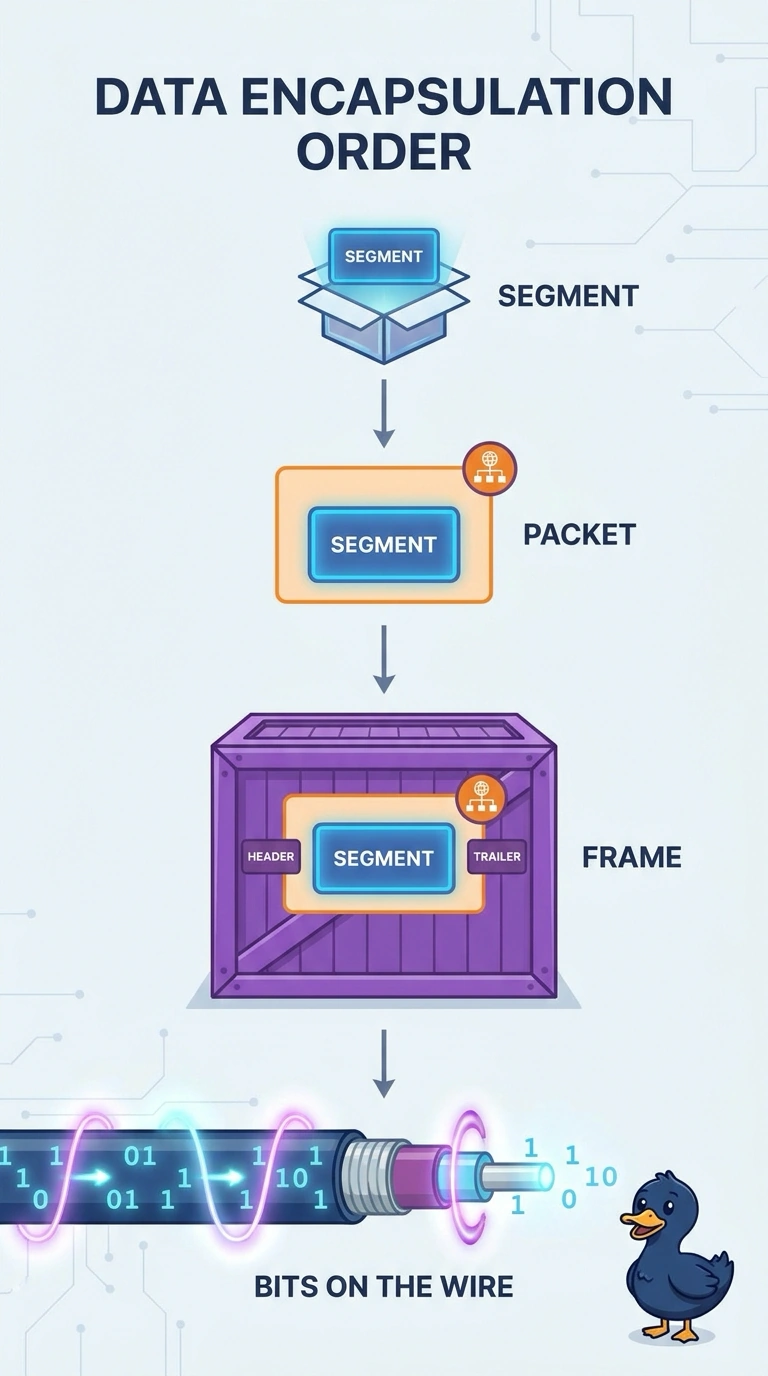
Picture packing a gift: the note goes in first, then the box, then the shipping crate, and only then does it ride the truck. Moving down the stack, you wrap a segment, then a packet, then a frame, and the physical layer sends bits. Starting with the crate, or with the truck, is the order running backwards.
Full Explanation
As data moves down the OSI stack for transmission, each lower layer adds its own wrapper. The transport layer creates a segment, the network layer wraps that in a packet, the data-link layer wraps the packet in a frame, and the physical layer puts bits on the medium. That is the sequence the campus instructor is asking for. Starting with a frame reverses data link and the layers above it. A frame is not built until a packet exists to carry. Starting with bits describes the receive path, where the physical layer hands a frame up to be unwrapped, not the transmit path the stem asks about. Putting a packet outside a segment reverses transport and network: the packet header is added after the segment exists. Exam caveat: the TCP/IP model uses fewer names, and this exam still expects the OSI order of segment, packet, frame, and bits. Operational check: in a capture, confirm an Ethernet header outside an IP header outside a TCP header, which is the on-the-wire result of that downward order. On the way back up, the wrappers come off in reverse, and a capture still shows the frame outside the packet outside the segment.