
A city-hall router decrements a field on every hop, discards the packet when the field reaches zero, and can send time exceeded. That same behavior lets traceroute map the path. Which field is it?
Select an answer to reveal the explanation.
Short Explanation
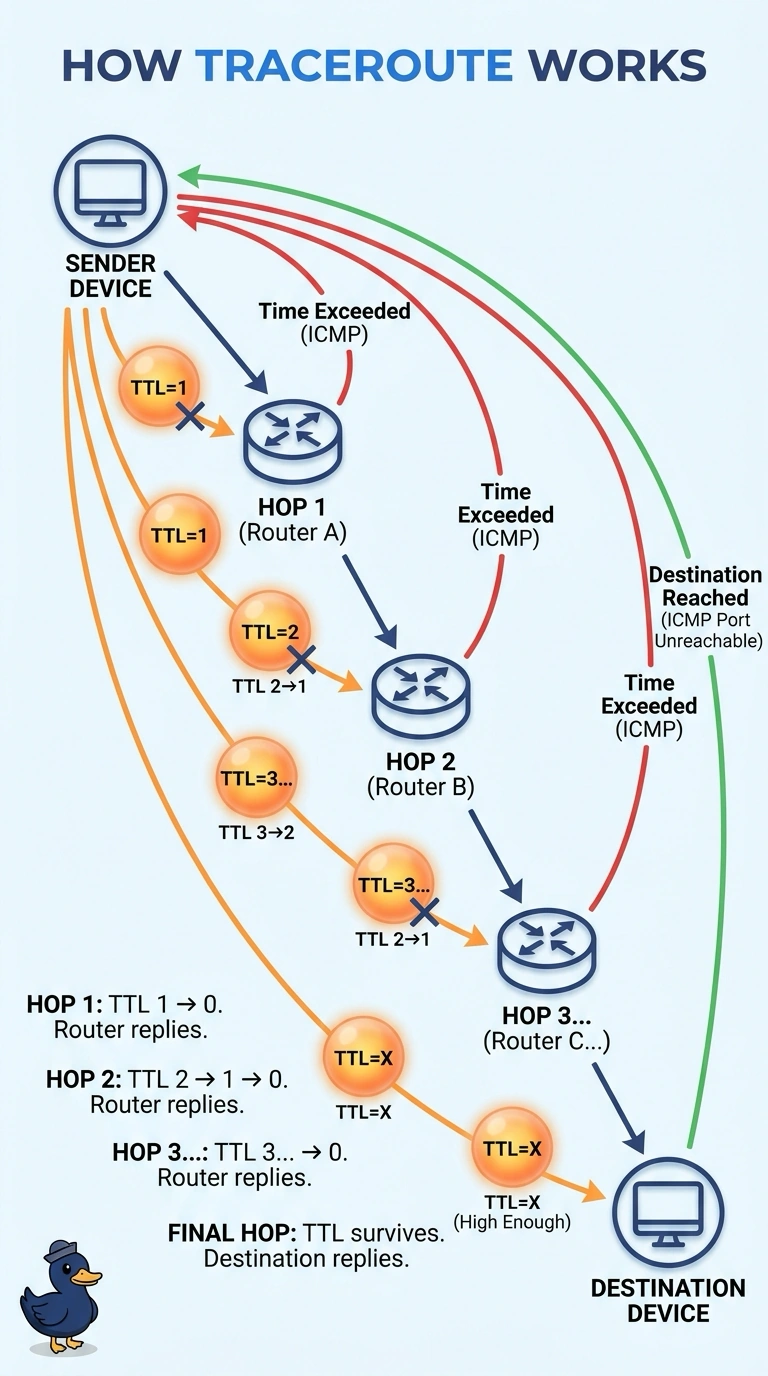
You can picture a punch card that loses one punch at every doorway and gets thrown out when the last punch is gone. That field is the time-to-live, and traceroute uses it by sending packets that expire at each successive hop. The Ethernet frame checksum, TCP receive window, and wireless network name are not counters that routers decrement hop by hop.
Full Explanation
The IPv4 time-to-live field is a hop counter: each router that forwards a packet decrements it. When its value reaches zero, the router discards the packet and can send an ICMP time-exceeded message to the source. Traceroute relies on this rule, sending probes with time-to-live values of one, then two, then three, and recording the router that reports time exceeded at each step until a probe reaches the destination. The city-hall behavior describes the time-to-live field. The Ethernet frame checksum detects damage to a frame on one link; a router does not decrement it, and a checksum error causes a frame to be dropped as damaged, not answered with time exceeded. The TCP receive window advertises how many bytes the receiver is willing to accept, providing flow control between endpoints; routers do not reduce it per hop, and traceroute does not vary it to find intermediate routers. The wireless network name identifies a radio service, not a hop counter in the IP header, so access points do not discard packets because it reaches zero. Exam caveat: IPv6 uses a hop-limit field that serves the same purpose. Practical check: run traceroute from city hall and observe replies as the probe count increases; each time-to-live expiry reveals the next router along the path.