
A student browser loads a school web page with HTTP, a protocol that sits at the top of the OSI model. Which layer is HTTP associated with on that model?
Select an answer to reveal the explanation.
Short Explanation
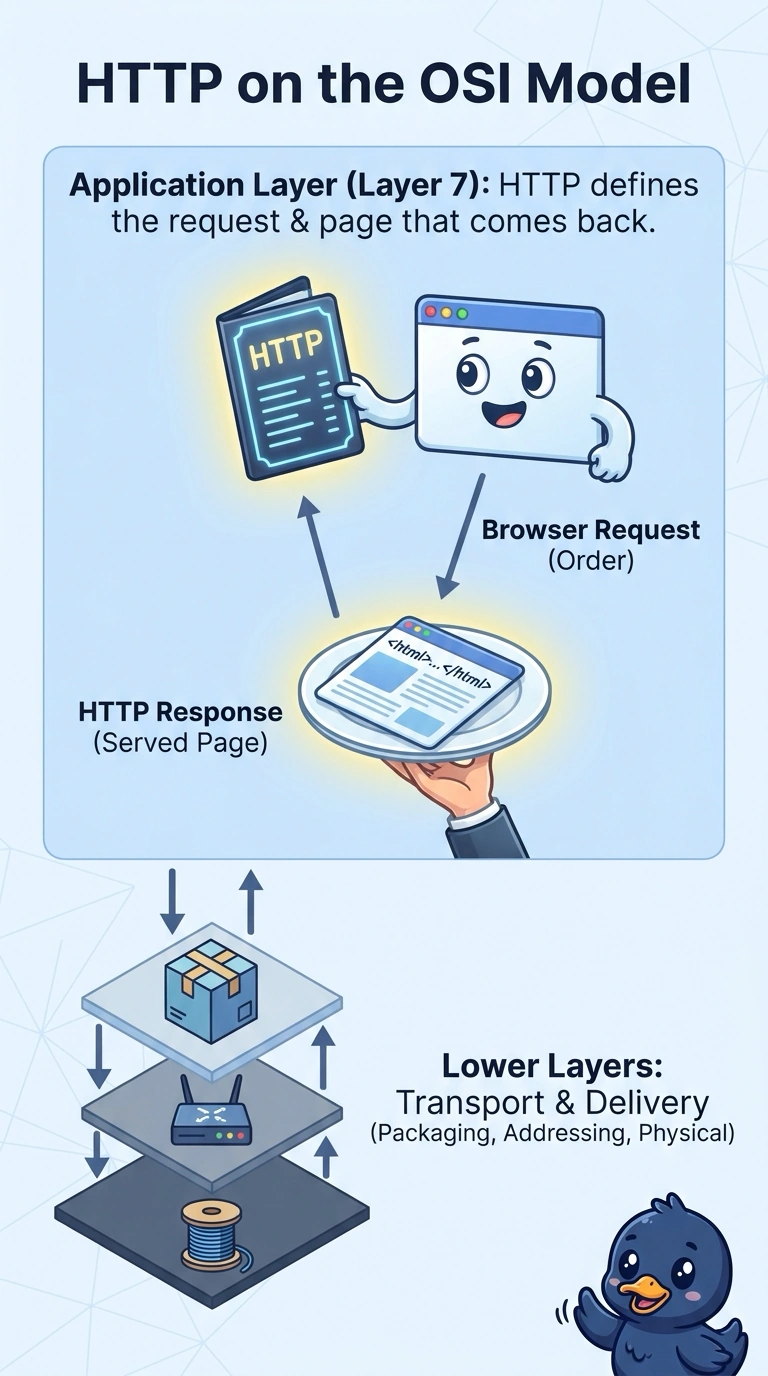
The browser and the web server are speaking a language about pages, and that language sits at the top of the stack. You are using HTTP, and on the OSI model this exam uses, HTTP belongs to the application layer. Choosing a route, delivering a frame on one link, or putting bits on the wire are the layers underneath that conversation.
Full Explanation
On the OSI model used by this exam, the application layer is where user protocols such as HTTP live. A browser loading a page sends an HTTP request and receives an HTTP response. Those messages are defined at the application layer, at the top of the model, and the lower layers exist to carry them. The network layer forwards packets according to the destination IP address and handles logical addressing. IP is doing that work under the HTTP message, and HTTP itself is not the forwarding decision. The data-link layer delivers frames across one link using hardware addresses. Ethernet or Wi-Fi framing is required for the page to arrive, and the frame format is not HTTP. The physical layer moves bits over copper, fiber, or radio. It has no idea that the bits represent a web page. Calling HTTP a physical-layer protocol confuses the signal with the application it carries. Exam caveat: real stacks map HTTP over TCP, and people often name the TCP/IP application layer rather than the seven-layer model. When the question says OSI, place HTTP at the application layer. Operational check: capture the session and confirm the payload is an HTTP request to the school page, then note that IP, Ethernet, and the wire are separate layers under that payload.