
On a busy factory link, voice must be queued ahead of the nightly backup so the backup cannot starve the calls. Which feature does that?
Select an answer to reveal the explanation.
Short Explanation
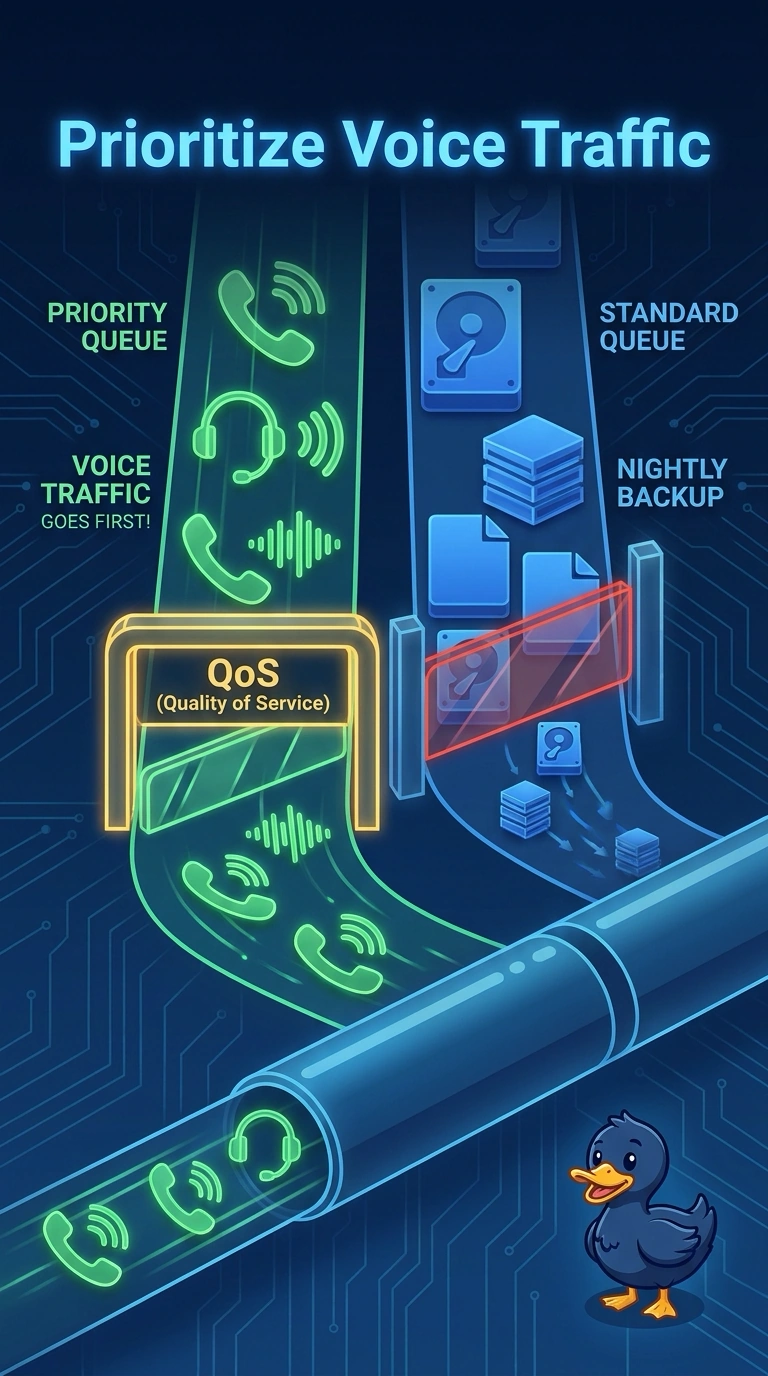
An ambulance gets the lane, and the freight truck waits. You need quality of service so voice is queued ahead of the nightly backup when the factory link is full. Buying a faster circuit, allowing bigger frames, or moving files closer to viewers does not put the calls in front of the backup.
Full Explanation
Quality of service classifies traffic and schedules it so a chosen class is sent before a less urgent class when a link is busy. Voice is sensitive to delay, and a bulk backup will fill a queue if both are treated alike. Queuing voice ahead of the backup keeps the calls served while the copy uses what remains. A faster circuit is the tempting twin. It can give the backup room, and it does not rank voice ahead of that backup the way the stem requires. A larger MTU lets a frame carry a bigger payload. It does not place voice in a priority queue, so the backup can still fill the link. A content delivery network stores content nearer to users. It does not sit on this factory link and decide that voice leaves before the backup. Exam caveat: the classification has to match the voice the phones actually send. A policy that marks the wrong traffic leaves the calls beside the backup. Operational check: during the backup window, confirm the voice queue is served first and that call quality holds while the backup still makes progress.