
A school lab is sorting four IPv4 addresses before a multicast exercise. Which address is the IPv4 multicast address?
Select an answer to reveal the explanation.
Short Explanation
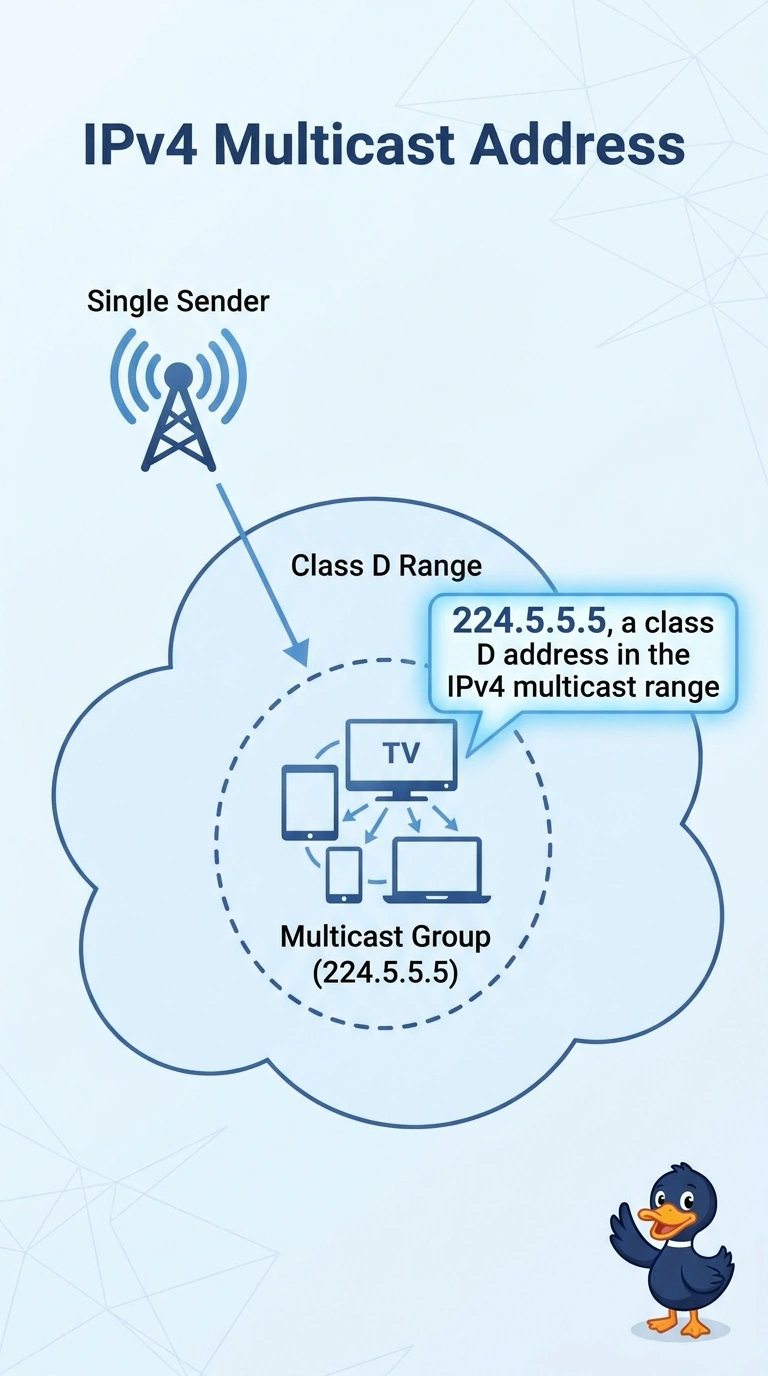
Multicast addresses are a reserved neighborhood, not just any number you can ping. You want 224.5.5.5, which sits in class D, the IPv4 multicast range. The class E address, the documentation address, and the private unicast address are all somewhere else.
Full Explanation
IPv4 multicast uses class D, the range 224.0.0.0 through 239.255.255.255. The address 224.5.5.5 falls inside that range, so it is a multicast group address and the one the lab should label for the exercise. Class E begins at 240.0.0.0 and runs through 255.255.255.255. The address 240.0.0.5 is class E, reserved rather than assigned as a multicast group, so it is not the multicast choice. The block 192.0.2.0/24 is set aside for documentation. The address 192.0.2.5 is a unicast documentation address used in examples. It is not inside class D and it is not an RFC 1918 private address either. The address 10.5.5.5 sits in 10.0.0.0/8, one of the RFC 1918 private unicast ranges, along with 172.16.0.0/12 and 192.168.0.0/16. Hosts use it as an ordinary private destination, and routers do not treat it as a multicast group. Exam caveat: not every class D address is available for an application to pick at random. Some low addresses are reserved for routing protocols, so a lab still chooses a group that is free for the exercise. Operational check: confirm the application joins 224.5.5.5 and that a capture shows the traffic destined to that group address rather than to 10.5.5.5 or 192.0.2.5.