
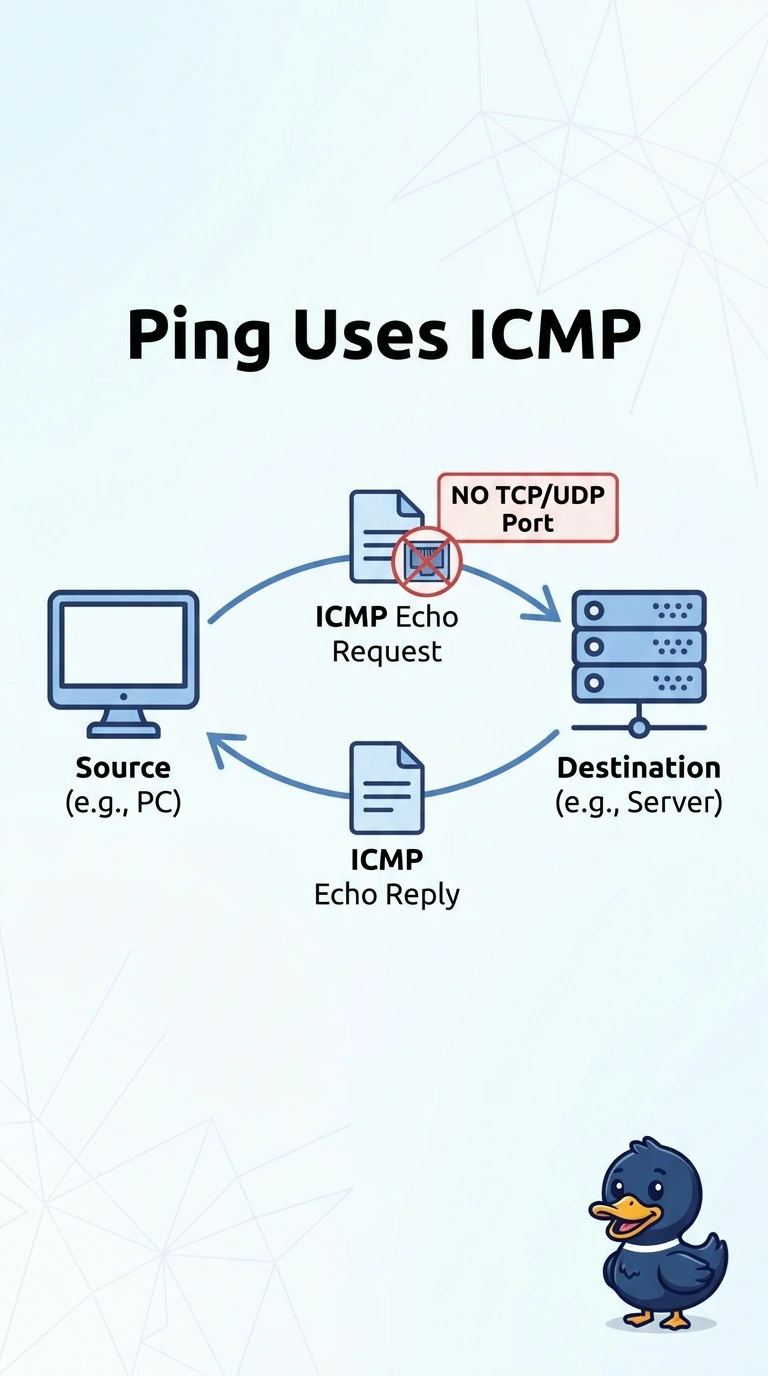
A campus filter drops ping to a server, yet browsers on the same PCs still open that server with HTTPS. Ping does not use a TCP or UDP port. Which protocol is ping using?
Select an answer to reveal the explanation.
Short Explanation
Ping is a knock, not a numbered loading dock. You can drop that knock and still leave the HTTPS dock on TCP 443 open, because ping rides on ICMP and never needed a TCP or UDP port. Wrapping packets in a tunnel, or sending logs to a collector, is not what the ping utility is doing.
Full Explanation
Ping sends an ICMP echo request and expects an ICMP echo reply. ICMP is its own network-layer protocol. It is not TCP and it is not UDP, so it has no TCP or UDP port number for a filter to match. A campus filter can discard ICMP and leave TCP 443 untouched, which is why browsers still open the server with HTTPS after ping has been blocked. That split is the evidence that ping is not HTTPS. Treating TCP 443 as the ping protocol confuses the application that still works with the test that failed. HTTPS uses TCP 443. Ping does not. GRE encapsulates one packet inside another so it can cross an IP network. It is a tunneling protocol, and the ping utility does not wrap its echo inside GRE. Syslog commonly sends event messages to UDP 514. A log collector can be down or blocked without any effect on whether ICMP echo is allowed, and syslog is not the protocol a ping uses to test reachability. Exam caveat: some devices rate-limit or fully disable ICMP while still forwarding TCP. A failed ping alone does not prove the server or the path is down. Operational check: while HTTPS to the server succeeds, capture on the path and confirm the dropped test is ICMP echo and that no TCP port is associated with it.