
Two buildings on a campus are 10 kilometers apart and need a fiber link at 10 gigabits. Which medium is the appropriate choice for that distance?
Select an answer to reveal the explanation.
Short Explanation
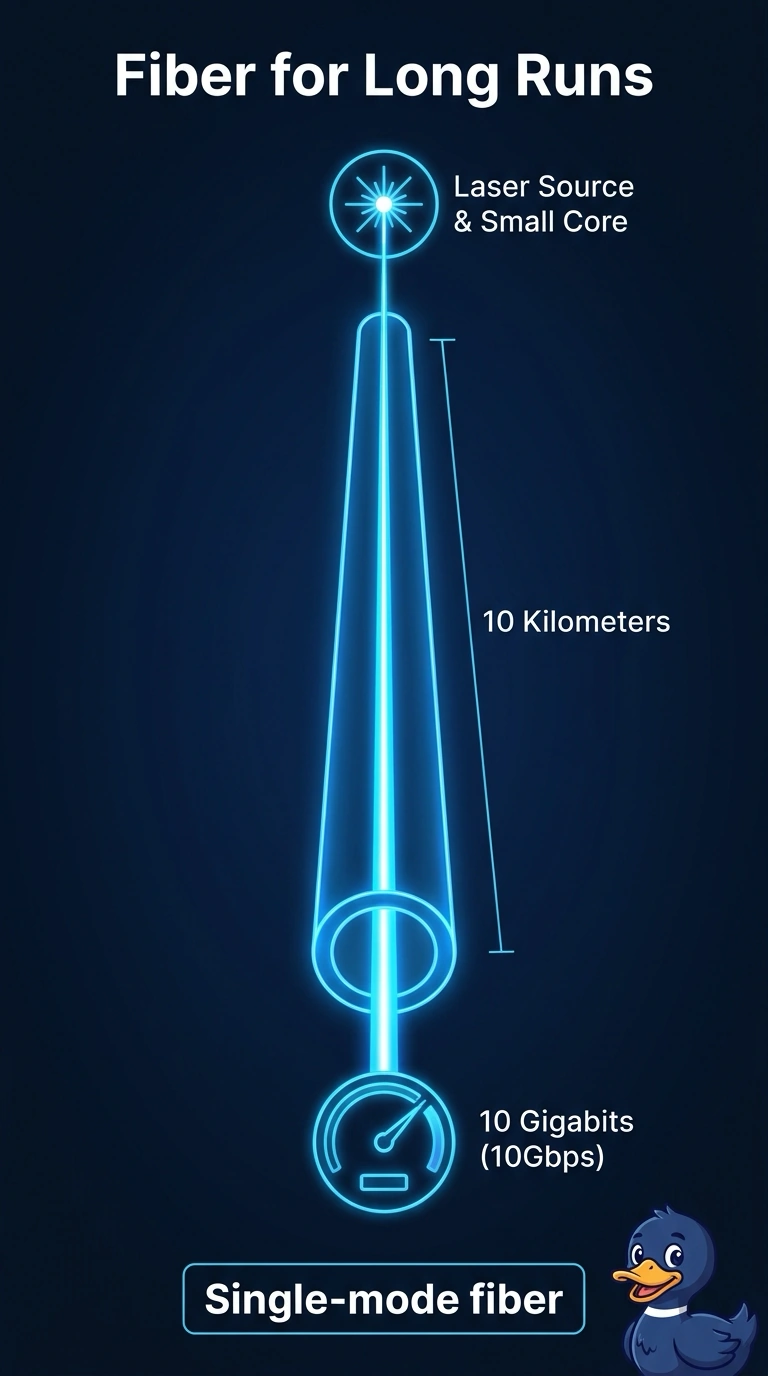
Multimode fiber is a short hallway, and single-mode is the highway between towns. At 10 kilometers and 10 gigabits you want single-mode fiber and the optics that match it. A higher OM grade stretches a short run, and it does not turn multimode into a 10 kilometer link, while category 6A stays a 100 meter channel.
Full Explanation
Single-mode fiber uses a small core and a laser so the light takes essentially one path. That is the medium used for multi-kilometer links, including a 10 kilometer run between buildings, with transceivers rated for that distance and speed. Multimode fiber uses a larger core and is intended for shorter distances inside a building or a campus. A larger core does not make it travel farther. OM4 is the tempting upgrade, because it is a better grade of multimode and it does carry 10 gigabits farther than older multimode, still on the order of a few hundred meters, not 10 kilometers. Category 6A carries 10 gigabit Ethernet over a 100 meter channel, not over an arbitrary distance, so a 10 kilometer copper run is far outside the standard. Exam caveat: the fiber type and the transceiver have to match. A single-mode strand with a multimode optic, or the wrong wavelength, fails even though the glass is the right kind for the distance. Operational check: confirm both ends use single-mode transceivers rated for at least 10 kilometers at the required speed, and measure received optical power against the optic's range after the strand is spliced.