
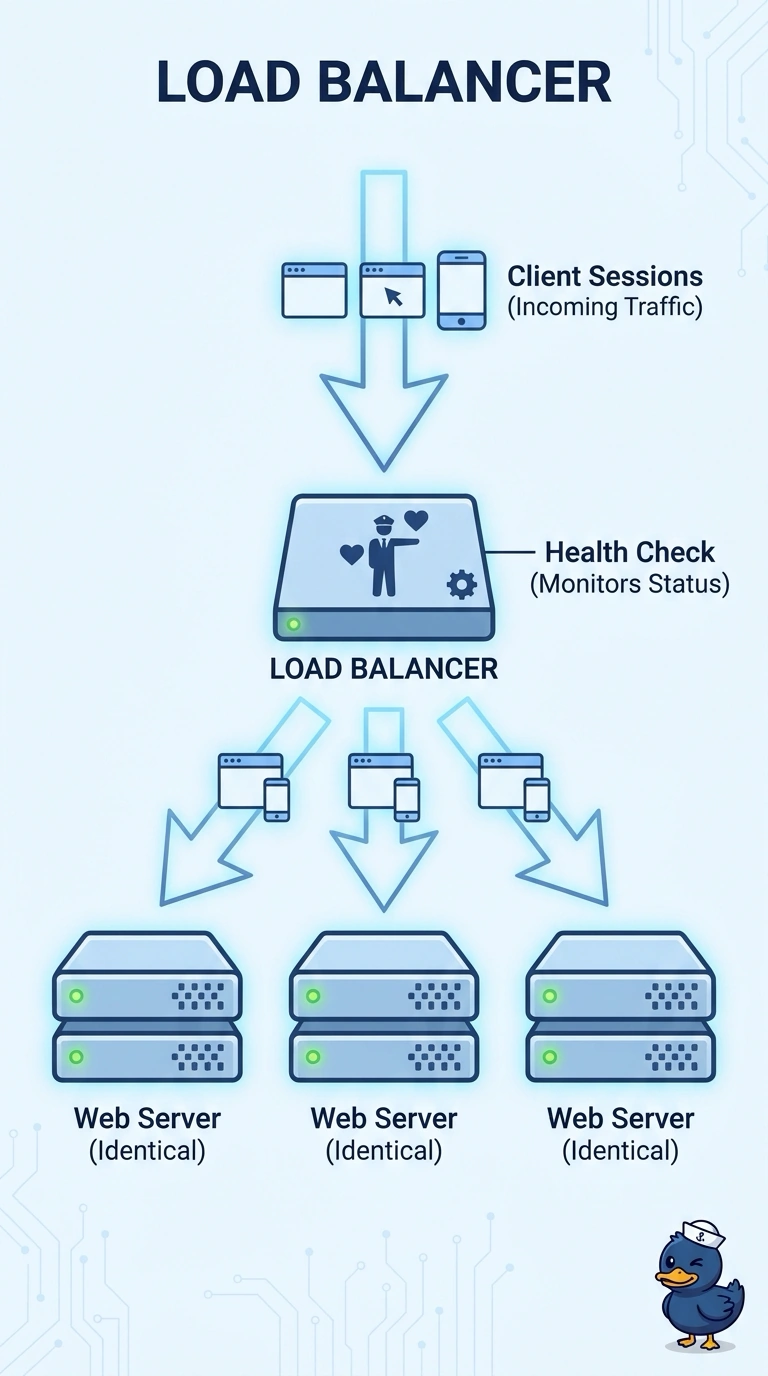
A retail site runs three identical web servers and wants a device in front of them that spreads client sessions and stops sending new sessions to a server that fails its health check. Which device does that?
Select an answer to reveal the explanation.
Short Explanation
Three checkout lanes only help if someone points shoppers at an open lane. You want a load balancer in front of the three web servers so one of them does not take every session and a dead server is skipped. Rotating the name in DNS spreads clients, and it does not pull them off a server that has already failed.
Full Explanation
A load balancer accepts client sessions, distributes them across a pool, and can stop offering a server that fails a health check. The retail site asked for that device in front of three identical web servers. Round-robin DNS is the near miss. It rotates the address handed to clients, so sessions spread, and a failed server stays in the rotation until someone edits the name. The stem's health check is the detail DNS does not do. A reverse proxy can sit in front and terminate the client session. Termination alone does not distribute, and a proxy that pins every request to the first server misses the spread. A virtual address configured on all three servers does not choose a healthy member. Without a distributor, the clients have no device deciding which server answers. Exam caveat: some proxies also balance load. Filtering or terminating a session is not that feature unless the device actually distributes and health-checks. Operational check: generate a burst of sessions and confirm each web server receives a share, then stop one server and confirm new sessions land on the remaining two.