
A planner must pick an address that is inside the RFC 1918 private space and will not be used on the public internet. Which address qualifies?
Select an answer to reveal the explanation.
Short Explanation
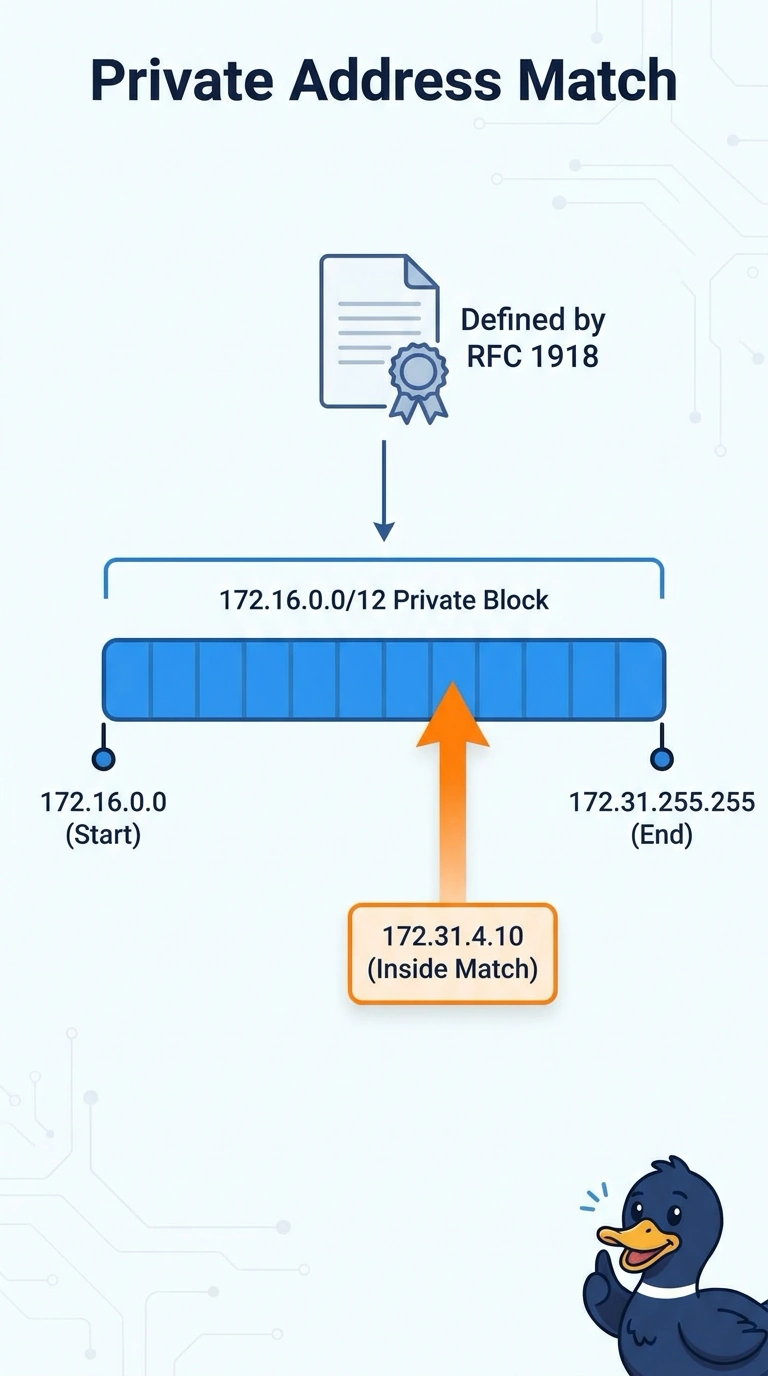
Private IPv4 space is three reserved neighborhoods, not every address that looks familiar. You can use 172.31.4.10 because the 172 private block runs from 172.16 through 172.31. The moment the second octet becomes 32, or you wander into 192.169, you have left the reservation and you are pointing at public space.
Full Explanation
RFC 1918 reserves 10.0.0.0/8, 172.16.0.0/12, and 192.168.0.0/16 for private networks. The 172 block is a /12, so the second octet runs from 16 through 31 inclusive. 172.31.4.10 is the last slice of that block and is private. 172.32.4.10 is the next address outside the /12. It is not part of the reservation and must not be used as if it were internal-only space. 192.168.0.0/16 stops at 192.168.255.255. 192.169.1.10 is a different /16 and is not private. 10.0.0.0/8 is private, and 11.0.0.10 is not inside it. It is ordinary public space. The class A label does not make 11 private just because 10 is private. Exam caveat: private addresses are not routable on the public internet by agreement. They are still ordinary IPv4 inside the organization, and they need translation or a proxy at the edge if a host using them must reach the public internet. Operational check: when you accept an addressing plan, test any 172 address against the range 172.16.0.0 through 172.31.255.255 and reject a second octet of 32 or higher.