
A retail chain wants checkout traffic to prefer each store's private circuit and guest wireless traffic to use the broadband circuit. The choice should follow one central policy as stores are added, without rewriting every router by hand. Which design fits?
Select an answer to reveal the explanation.
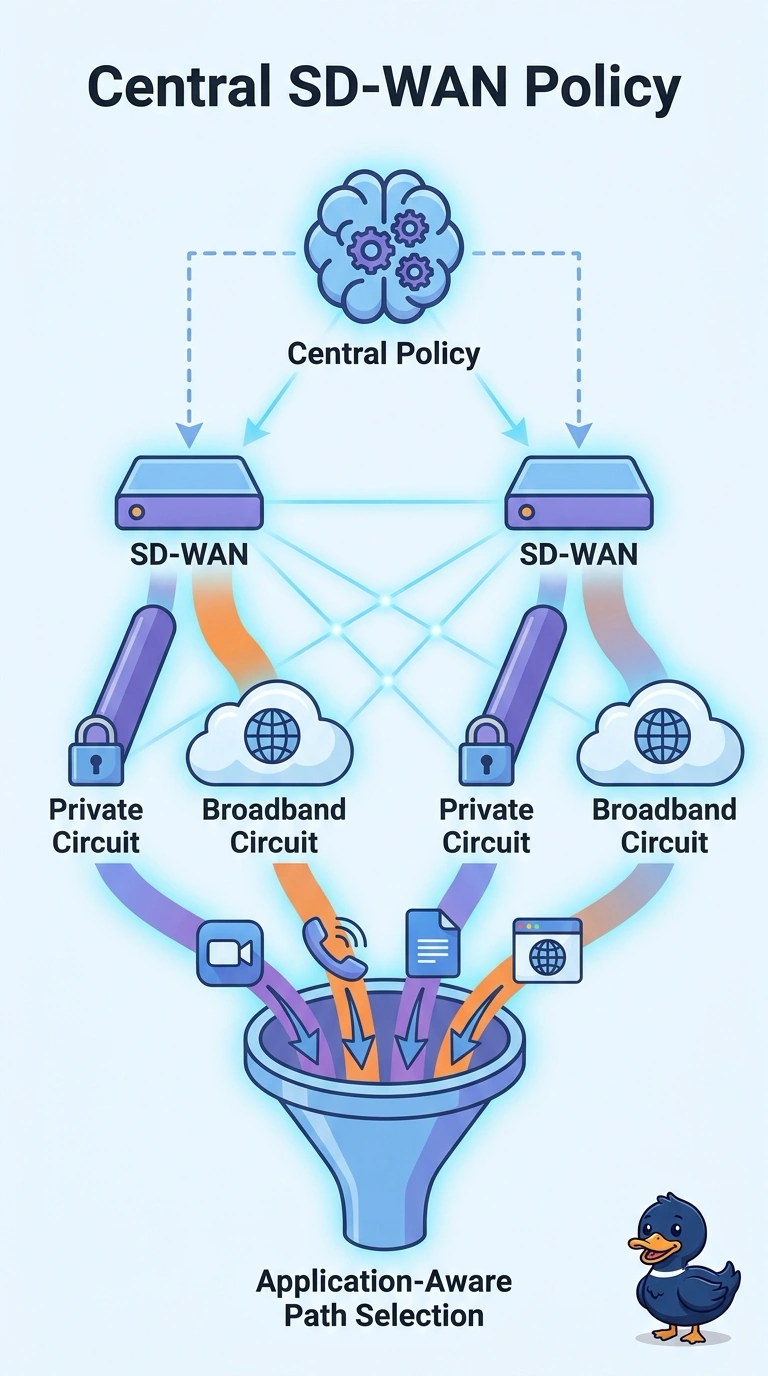
Short Explanation
You want the network to notice which application is talking and send it down the road you picked at headquarters. That is what software-defined WAN is for: one central policy, applied at each store, that can treat checkout differently from guest wireless. One default route cannot tell those two flows apart.
Full Explanation
Software-defined WAN separates the decision about which transport to use from the individual circuits underneath. A central policy can identify an application and send it on the preferred transport, and the same policy is applied as new stores come online instead of being typed into each router. Checkout traffic preferring the private circuit while guest traffic uses broadband is exactly that application-aware, centrally managed choice, and the design is also transport agnostic because either circuit can carry either flow when policy says so. A single static default route sends everything unknown toward one next hop. It cannot prefer one circuit for checkout and another for guests. OSPF inside one store can pick a best path by cost for a prefix. It does not, by itself, give headquarters an application-level policy that is pushed to every new store, and a single OSPF preference would treat checkout and guest traffic the same if they share a destination. VXLAN encapsulates layer-2 traffic so a segment can stretch across a layer-3 underlay. Stretching the guest wireless VLAN onto the point-of-sale terminals would mix two zones the policy is trying to treat differently. Exam caveat: SD-WAN does not remove the need for the circuits. It chooses among the transports you already have, and a store with only one working circuit has nothing to steer. Operational check: mark a checkout flow and a guest flow at a pilot store and confirm each one takes the circuit the central policy names, then add a lab store and confirm it receives the same policy without a hand-built route.