
An insurance office replaces a shared hub with a switch. Stations on the same VLAN still hear broadcasts together, but a known unicast frame is no longer repeated out of every port. Which decision is the switch making?
Select an answer to reveal the explanation.
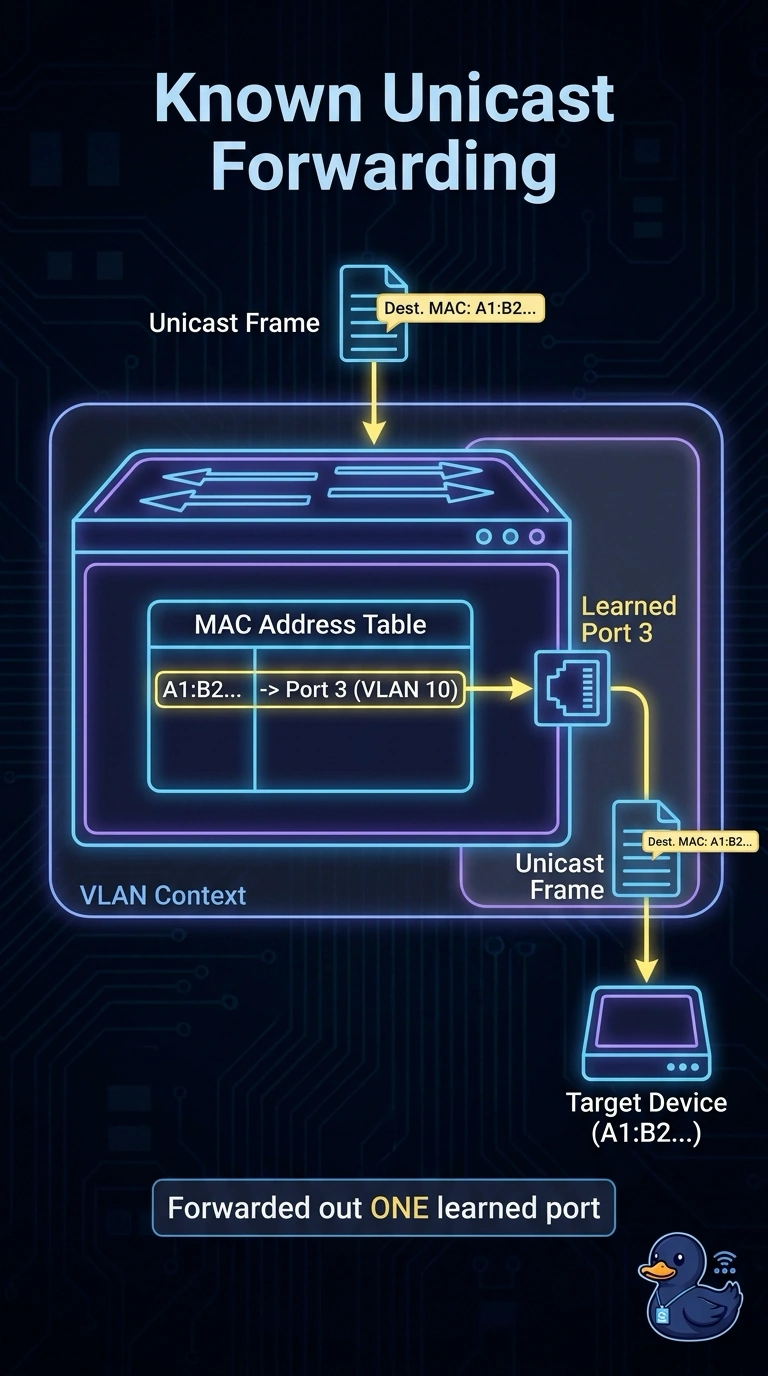
Short Explanation
Think of a hub as a shout across a crowded room and a switch as a receptionist who has learned everyone's seat. You still share one broadcast domain inside the VLAN, but unicast traffic goes only to the port where that MAC address was learned. Don't promote the switch into a router just because it got smarter than a hub.
Full Explanation
A switch is a data-link device. It records source MAC addresses as frames arrive, then forwards a known unicast frame only out the port where that destination MAC was seen. Broadcasts and unknown unicasts are still flooded, so stations on one VLAN continue to share a broadcast domain, which is exactly what the office observed after the hub was removed. Choosing an IP next hop is a network-layer decision. It is the tempting explanation for why flooding stopped, and it is not required here: the frame never left the VLAN, and broadcasts still reach every station in it. Flooding a known unicast out every other port is what the hub did. The new behavior is the opposite, so that description names the device that was removed. Terminating a TCP session is a transport-layer job of the endpoints. A switch does not have to finish a session before it can pick an egress port from the MAC table. Exam caveat: many switches can also route, but MAC learning with an intact broadcast domain is still the layer-2 switching function. Operational check: look at the MAC address table and confirm the destination host's MAC appears on only one access port, then verify a unicast frame to that MAC is not flooded out the other access ports.