
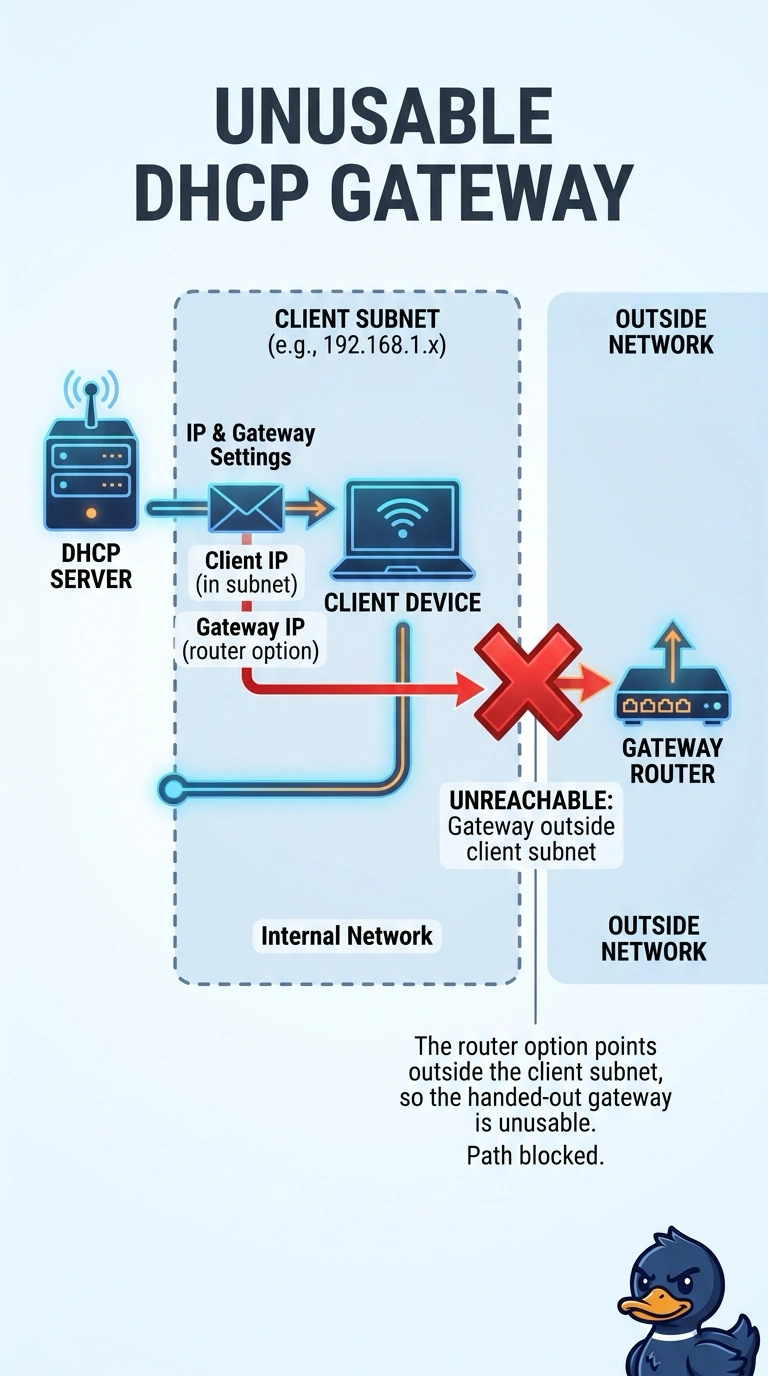
Every PC in a retail VLAN received the same DHCP gateway, and that gateway address is not inside the PCs' subnet. The PCs ping each other and cannot ping the gateway. Which fault is this?
Select an answer to reveal the explanation.
Short Explanation
Every register got the same bad forwarding address from the clerk, and that address is not even on their street, so you can still see them talk to each other and they cannot knock on a gateway that is not local. The clerk is DHCP, and the bad address is the router option. An empty pool, a reverse name, or a fiber pair does not hand out one off-subnet gateway to everybody.
Full Explanation
A DHCP router option becomes the clients' default gateway. The gateway has to be an address inside the clients' own subnet, because the client uses it as the on-link next hop. Here every PC received the same gateway and that address is outside the subnet, so the PCs can still reach each other by ARP and cannot use the gateway. The fault is the router option. Pool exhaustion stops new clients from getting a lease or pushes them to an automatic private address. It does not consistently hand out an off-subnet gateway while leaving same-subnet pings working. A missing PTR record affects reverse DNS. It is not used when two PCs ping each other by IP. Swapped fiber transmit and receive strands take a fiber link down. They do not rewrite a DHCP option, and same-subnet traffic in this VLAN is already working. Exam caveat: a single PC with a manually typed gateway can show the same symptom. When every PC agrees, the scope is the place to look. Operational check: read the scope's router option, set it to the real gateway in that subnet, renew the PCs, and confirm the new gateway answers.