
Clinic PCs on VLAN 30 can ping their gateway. PCs on VLAN 40 have addresses but cannot ping the VLAN 40 gateway, and that switch virtual interface is shut down. Traffic between the VLANs fails. Which fault is this?
Select an answer to reveal the explanation.
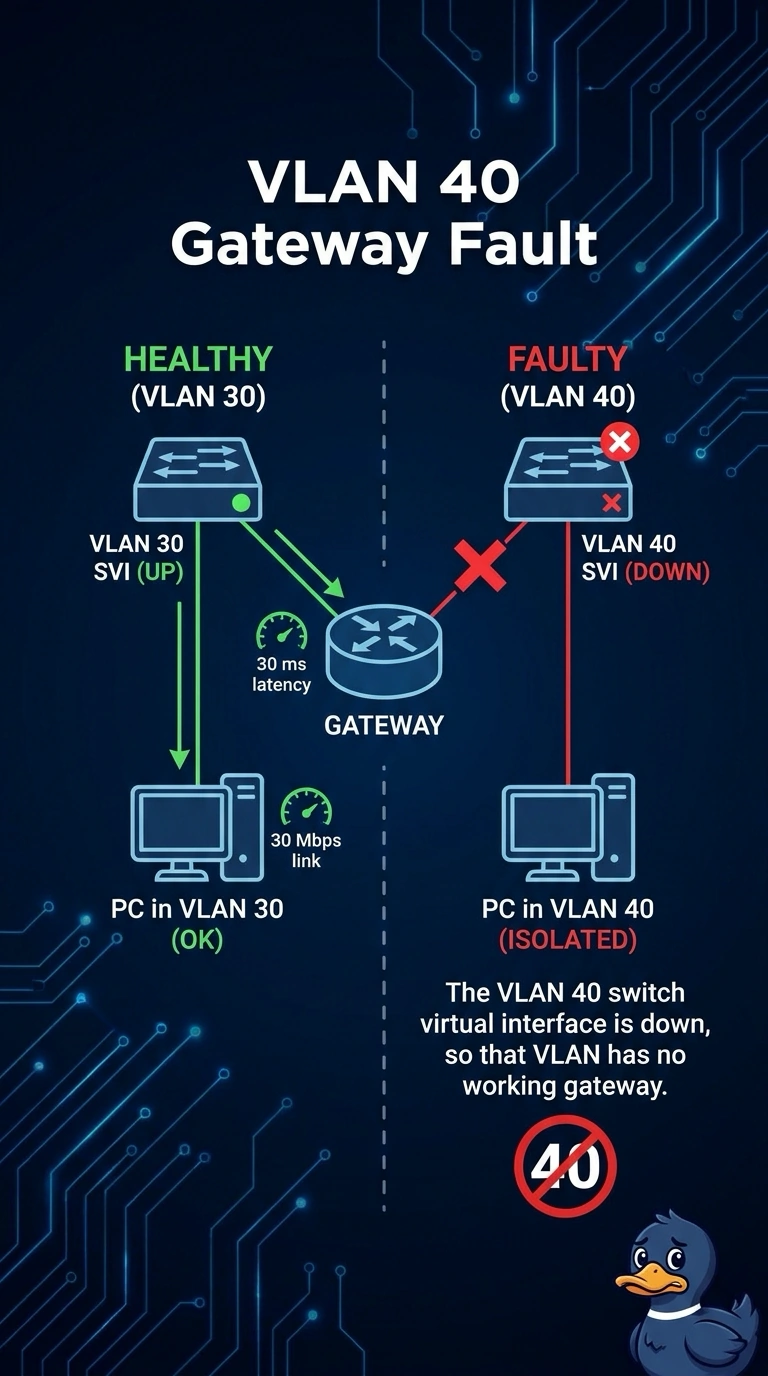
Short Explanation
You can see the difference clearly: VLAN 30 reaches its gateway, while VLAN 40 cannot because its switch virtual interface is shut down. Adding DHCP addresses, publishing a reverse name, or retuning a wireless channel will not bring that gateway interface up.
Full Explanation
Inter-VLAN routing on a Layer 3 switch uses a switch virtual interface (SVI), with an IP address in the VLAN, as the hosts’ gateway. VLAN 30’s interface answers pings, so that VLAN’s gateway is up. VLAN 40’s hosts cannot ping their gateway, and the scenario states that its SVI is shut down; packets leaving VLAN 40 therefore have no working gateway, so traffic between the VLANs fails. DHCP pool exhaustion could cause automatic private addresses or prevent new leases, but it would not shut down an SVI, and these hosts already have addresses. A missing PTR record can cause some mail servers to reject delivery, but it is not consulted when a host pings a gateway by IP address. Wireless channel overlap causes radio retries; it does not administratively disable a wired SVI. Exam caveat: an SVI can also be down because its VLAN has no forwarding port, which can produce a similar ping failure. Here, the stated cause is that the interface was shut down, so bring it up after confirming the VLAN exists. Practical check: inspect the SVI state, bring it up through change control, and ping it from a VLAN 40 host before testing a host on VLAN 30.