
Two wall jacks in a school lab were patched together with a cable. Utilization on every port spikes, MAC addresses flap between ports, and spanning tree is turned off on that switch. Which fault explains it?
Select an answer to reveal the explanation.
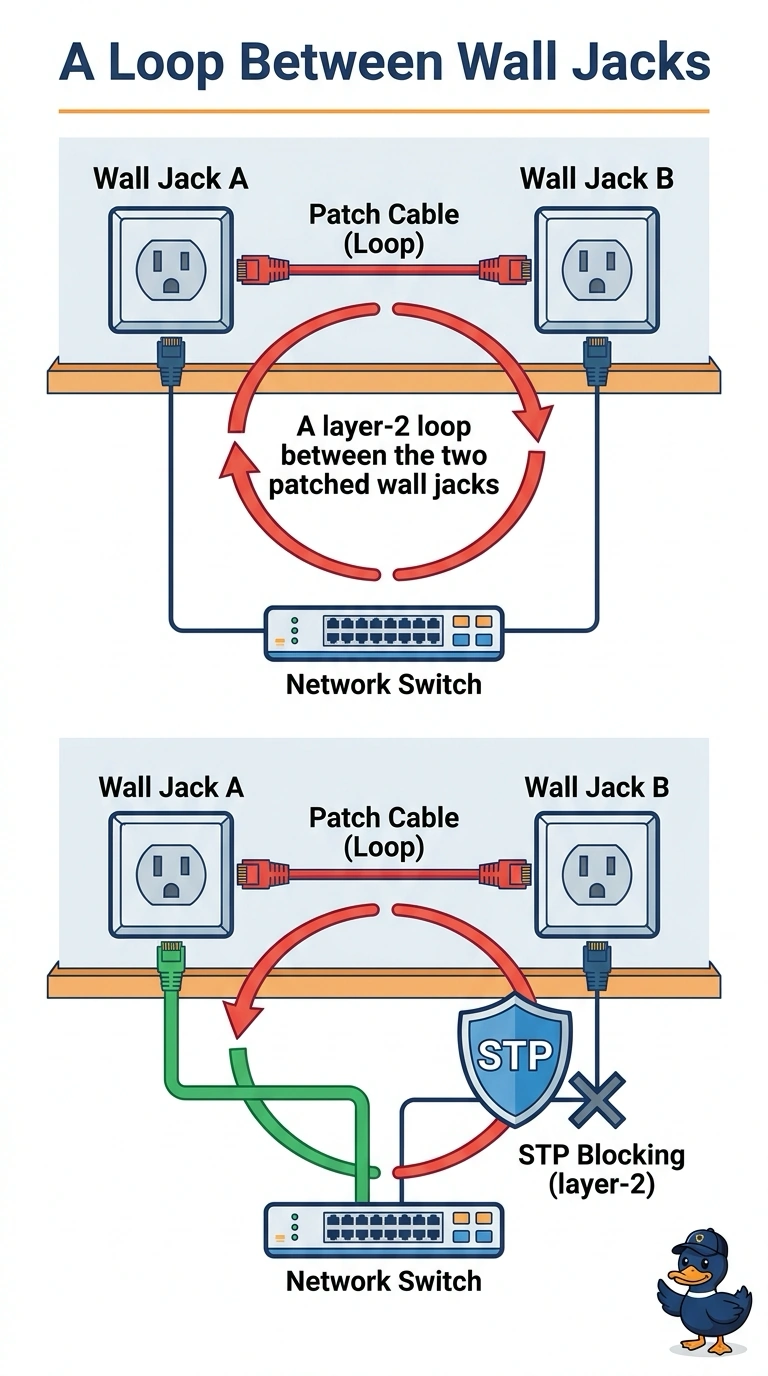
Short Explanation
Patching two wall jacks together is like opening a second door between the same two rooms and then dismissing the usher. You built a layer-2 loop, spanning tree is off so nobody blocks it, and the lab switch floods until utilization spikes and MAC addresses flap. A duplex mismatch or a full MAC table does not need those two jacks tied together.
Full Explanation
A layer-2 loop forms when a switch can reach itself through two paths and nothing blocks one of them. Patching two wall jacks together ties two access ports into that circle. With spanning tree off, neither port is blocked, broadcasts circulate, utilization climbs, and the same MAC addresses flap between the ports. A duplex mismatch causes errors and can hurt throughput. It does not require a cable between two jacks or spanning tree to be disabled, and it does not move one MAC back and forth as a loop does. A full MAC table floods unknown unicasts. The stem says spanning tree is off and the jacks were patched, which is a loop, not a table that filled while spanning tree was still blocking. A routing loop expires IP packets by their hop count. It does not flap MAC addresses on one switch. Exam caveat: spanning tree, when it is on, would block one of the two jacks and hide the patch. Operational check: remove the cable, confirm utilization and the flaps settle, then turn spanning tree back on.