
An unlabeled copper drop in a school closet must be identified at the patch panel without guessing which port it uses. Which tool pair does that job?
Select an answer to reveal the explanation.
Short Explanation
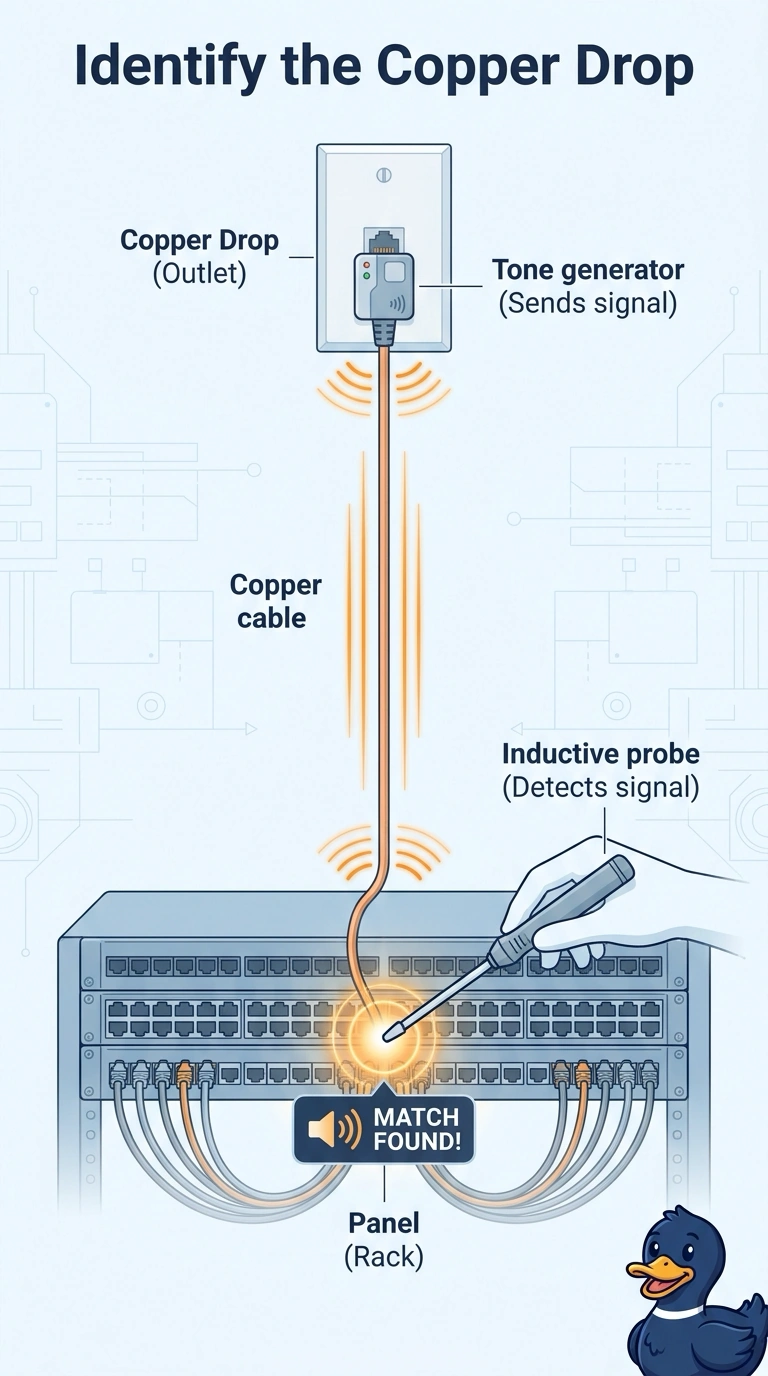
A tone generator is a whistling tag you clip to one copper pair, and the probe is how you hear which jack is whistling. You put the tone on the unlabeled school drop and sweep the patch panel until the probe sings, instead of guessing. A certifier needs you to know both ends already, and a punch-down tool only seats the copper.
Full Explanation
A tone generator places an analog tone on a copper pair. An inductive probe at the panel hears that pair, so you can find one unlabeled drop among many ports without unplugging circuits at random. A visual fault locator injects red light into a fiber. It finds a break or a bend in glass, and it does not couple to this copper drop. A cable certifier is the near miss, because it is the right family of copper tool, and it grades length, crosstalk, and the wire map only after you have the drop and the panel port in the same test. It does not discover which port an unlabeled cable uses. A punch-down tool terminates pairs on a jack. It does not identify the far port. Exam caveat: a tone can bleed onto adjacent pairs, so listen for the loudest port and confirm with a wire map once the port is known. Operational check: tone the drop, mark the panel port where the probe is loudest, update the cable map, and only then move a patch cord. If two ports sound close, unplug nothing until a second pass picks a clear winner.