
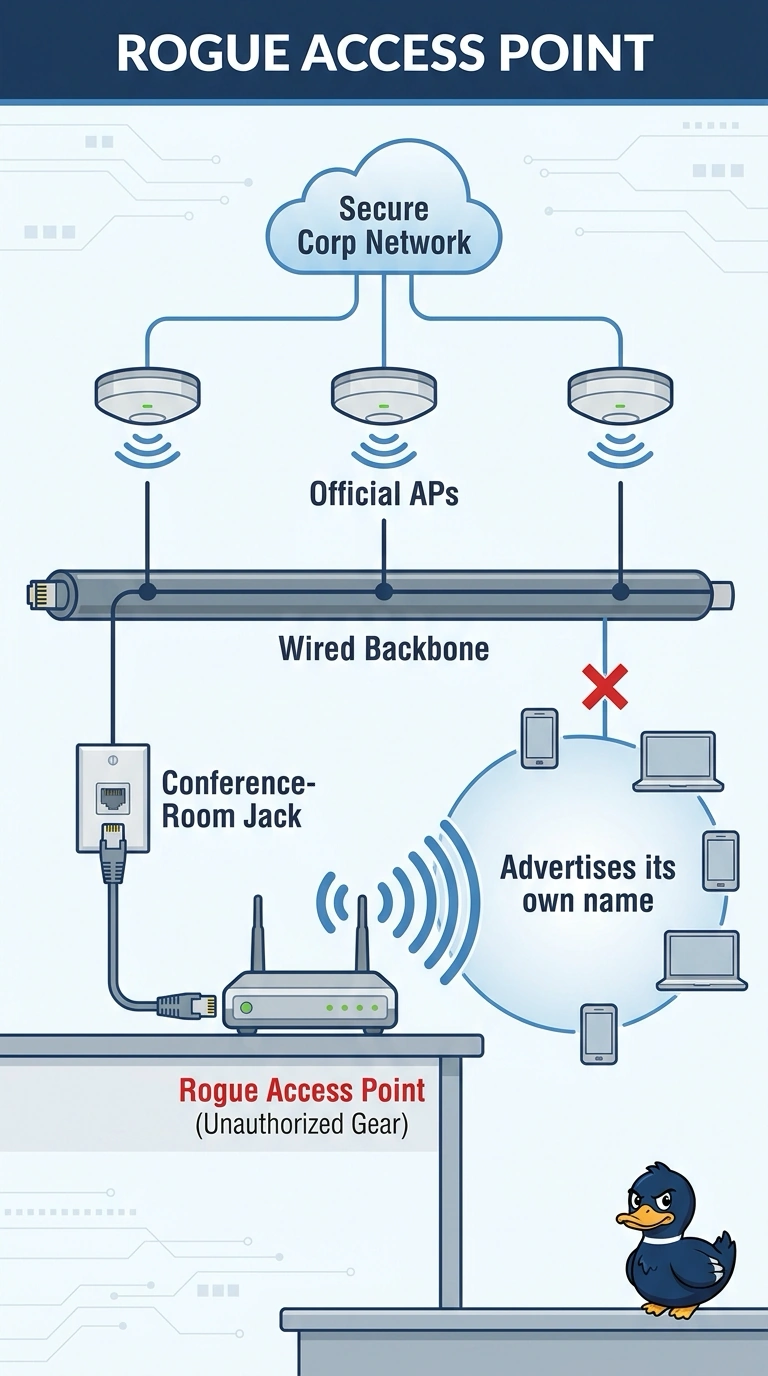
Someone plugged an unauthorized access point into a conference-room jack at a factory. It advertises its own network name, not the factory's name. Which attack is this?
Select an answer to reveal the explanation.
Short Explanation
A stranger set up a shop on your network and hung a different sign over the door, so the shop was not invited and the sign is not a copy of yours. That is a rogue access point. A copy of your sign would be an evil twin, and a forged ARP table or a fake email is a different scheme.
Full Explanation
A rogue access point is an unauthorized wireless access point connected to the network. This one is plugged into a factory jack and advertises its own SSID rather than the factory name, so clients who join it are on an unapproved device that still has a path onto the wired network. An evil twin copies a legitimate SSID to impersonate the real network. Using a new name is the opposite of that impersonation. ARP poisoning forges IP-to-MAC mappings so traffic is redirected. It does not describe installing an access point. Phishing is a fraudulent message that tricks a person. It does not require, and it is not defined by, a cable into a conference jack. Exam caveat: a rogue access point can be a well-meaning employee hotspot. It is still unauthorized, and it still bypasses the wireless controls you set on the real access points. Operational check: trace the access point's MAC to the switch port, disable that port, remove the device, and turn on a scan that alerts on unknown access points.