
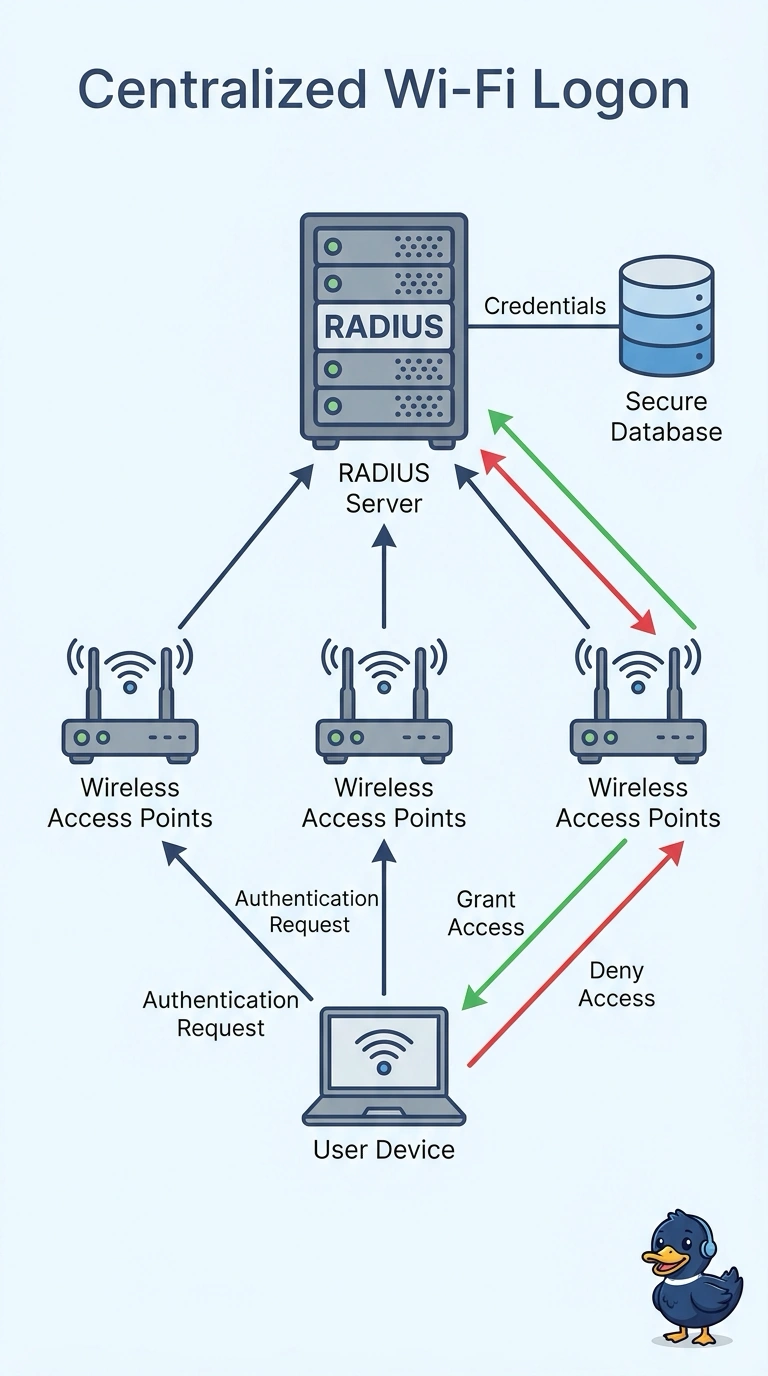
A city office wants each laptop to log on to the wireless network with an account checked by a central server. Device command authorization is a later project. Which service should the access points use for that logon?
Select an answer to reveal the explanation.
Short Explanation
The access point is a bouncer checking names against a club list that lives on a server, not a guard who also decides which commands you may type on a router. That network-logon check is RADIUS. The trap is reaching for TACACS+ because it is also an AAA service, when this office asked for wireless logon and left device administration for later.
Full Explanation
RADIUS is the AAA service network devices typically use when an access point or switch must authenticate a user or endpoint against a central server. The city office wants that network logon, and it has postponed command-level administration of the network gear, so RADIUS matches the request. TACACS+ is the AAA service typically used to control administrative access to network devices, including command authorization. It is the later project, not the wireless logon. A hosts file maps names to addresses on one computer. It does not authenticate a user to an access point. DNSSEC signs DNS records so a resolver can detect tampering. It does not carry user credentials to a wireless network. Exam caveat: enterprise Wi-Fi often pairs RADIUS with 802.1X, and the stem's central account check is that pattern even though the question asks for the AAA service. Operational check: point the access points at the RADIUS server, confirm a test account is accepted, and keep TACACS+ on the plan for device administration.