
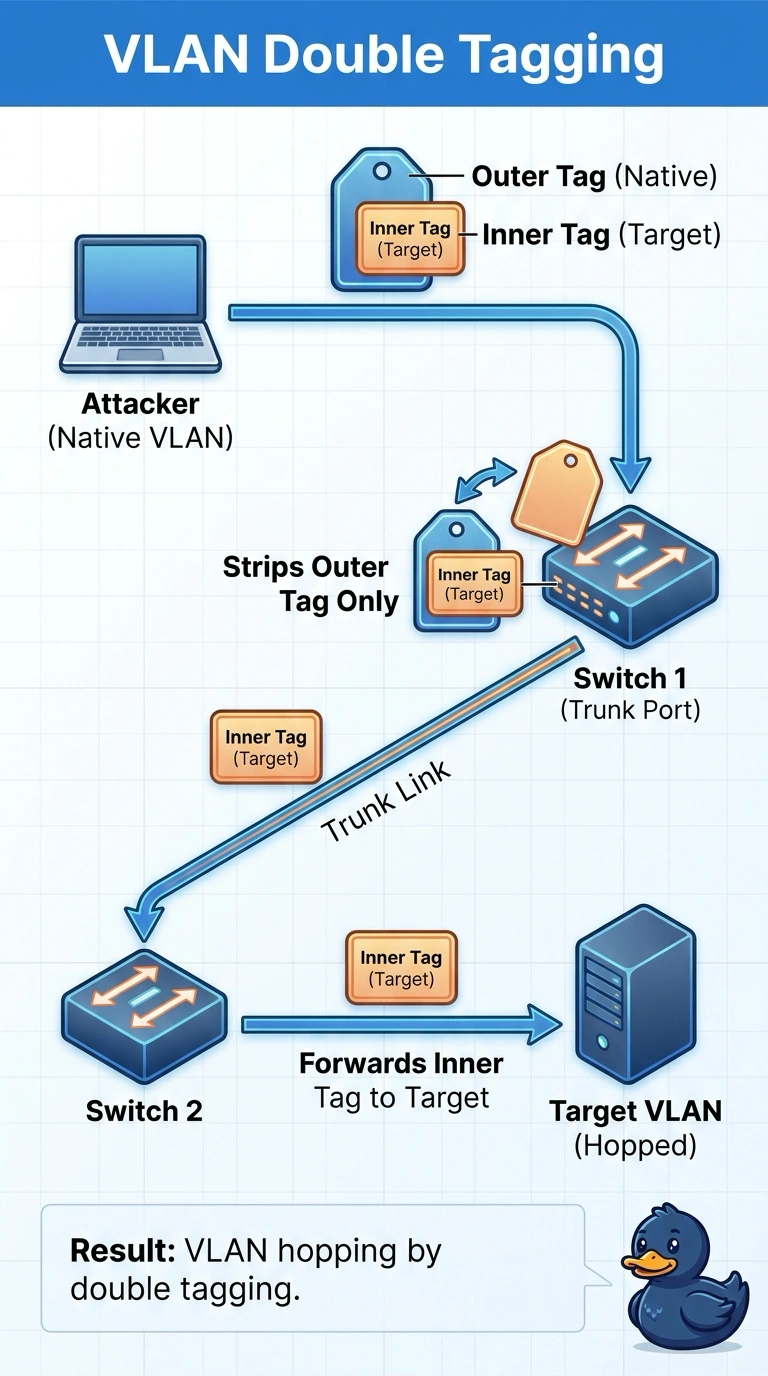
An attacker on a campus switch's native VLAN sends a frame that carries two VLAN tags. The first switch strips the outer tag, and the inner tag delivers the frame into another VLAN. Which attack is this?
Select an answer to reveal the explanation.
Short Explanation
Imagine a suitcase with two luggage tags, and the first checkpoint peels only the outer one. You still have a tag for a different room, and that is VLAN hopping by double tagging. Switch spoofing talks the switch into a trunk instead of hiding a second tag, and a native VLAN mismatch has no attacker-built inner tag.
Full Explanation
Double tagging is a VLAN hopping method. The attacker sits on the native VLAN and sends a frame with two 802.1Q tags. The first switch treats the outer tag as native, strips it, and forwards the frame. The inner tag is still there, and the next switch places the frame in the VLAN the attacker chose. Switch spoofing is the other VLAN-hopping method and the real near miss. The attacker negotiates a trunk, often by abusing dynamic trunking, and then sends tagged frames as if the port were a trunk. The stem has no negotiation. It has two tags and a first switch that strips only the outer one. A native VLAN mismatch also moves traffic into an unexpected VLAN, and it does that to ordinary untagged frames when two switches disagree. Nobody inserted an inner tag. MAC flooding overflows the address table so frames are flooded. It stays inside the VLAN the attacker is already on. Exam caveat: double tagging is usually one-way, and it fails when user ports are not on the native VLAN. Operational check: confirm user ports are not members of the trunk's native VLAN, and look for unexpected double tags on the trunk from that port.