
A technician in a hospital closet needs to know which rack unit holds the firewall. Cable paths and IP subnets are already documented. Which drawing answers that?
Select an answer to reveal the explanation.
Short Explanation
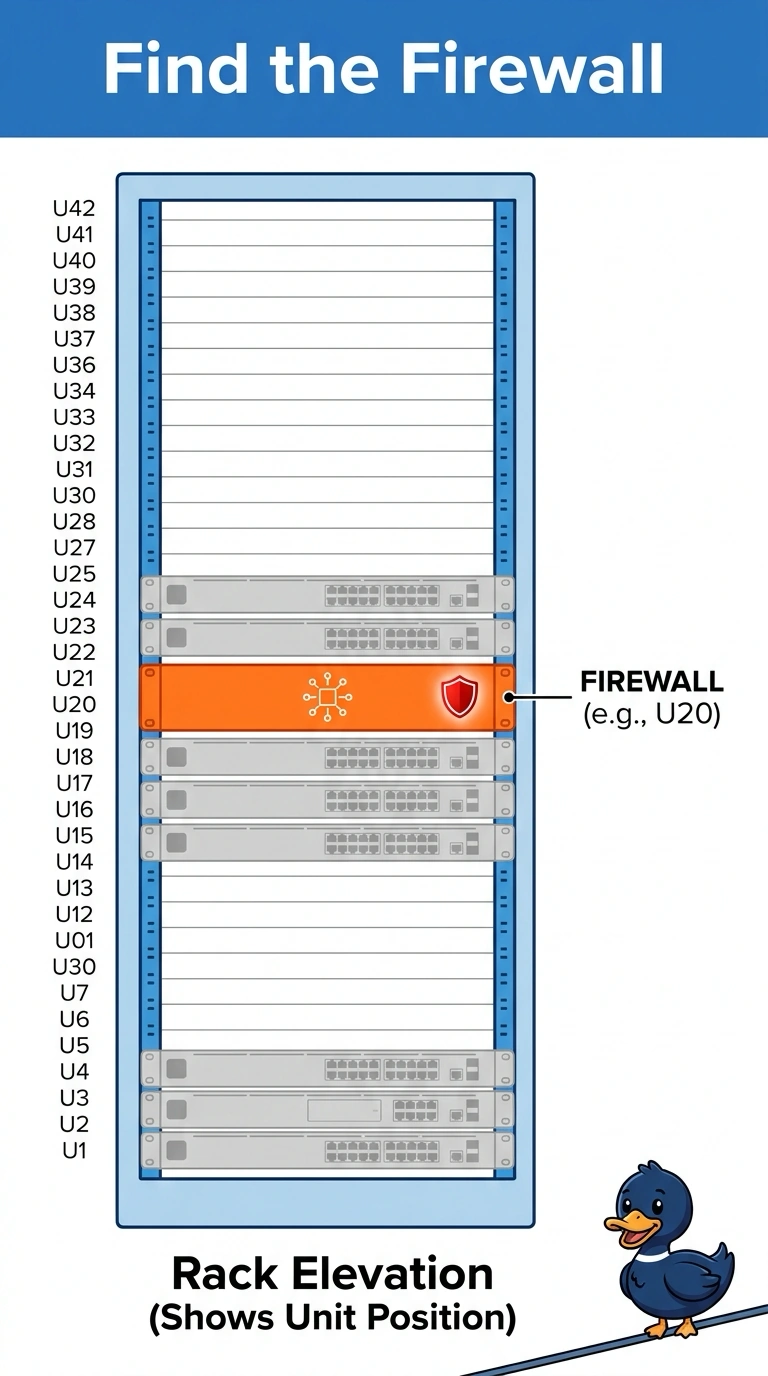
You already know the street map and which cord goes where, and what you still need is the shelf number of the firewall. That picture is the rack elevation. A radio heatmap will not point at a rack unit.
Full Explanation
A rack elevation is a front view of the rack that shows which device occupies which rack unit. The technician needs the firewall's unit position, and the cable paths and subnets are already documented, so the elevation is the drawing that answers. A logical diagram shows addressing and routed paths. It does not show physical rack units. A cable diagram traces runs from faceplates to panels. It answers a tracing question, which this closet is not asking. A wireless heat map records signal on the ward. It has no rack-unit scale. Exam caveat: a rack elevation goes stale when gear is moved and the drawing is not updated, so the labels on the rack should match the drawing you are reading. Operational check: stand at the rack, match the unit number on the elevation to the firewall, and correct the drawing if the device was moved. If two devices share a unit number on the drawing, the elevation is wrong and the labels on the rack are the tie-breaker until you redraw it. Update the elevation the same day the firewall moves.