
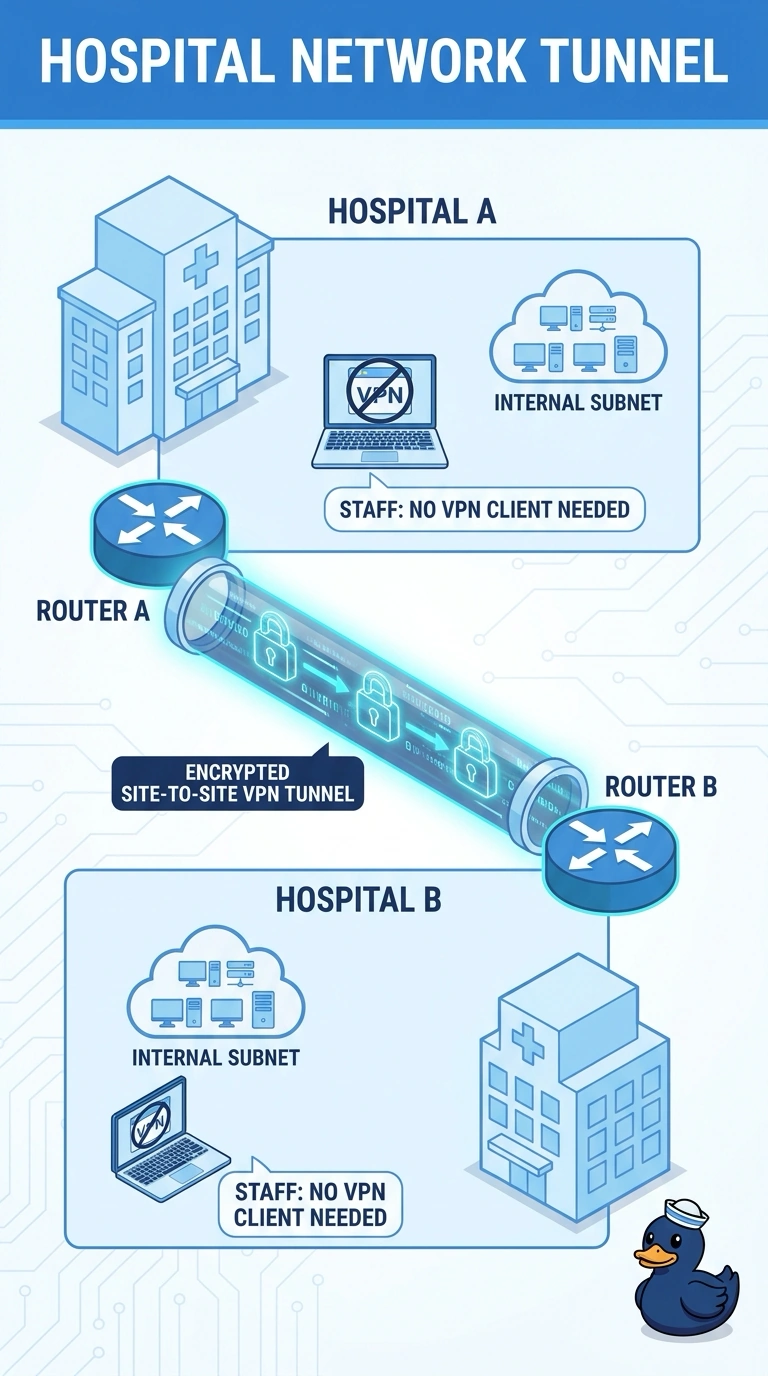
Two hospital buildings need their internal subnets to reach each other through an encrypted tunnel. The routers will bring the tunnel up, and staff must not launch a VPN client. Which VPN fits?
Select an answer to reveal the explanation.
Short Explanation
You want the two buildings' front doors bolted together so every room can visit every room, without asking each person to open a private side door. That building-to-building bolt is a site-to-site VPN. A browser portal, a laptop tunnel setting, or a serial console solves a different access problem.
Full Explanation
A site-to-site VPN is built between two routers or firewalls so the subnets behind them can reach each other. The tunnel comes up with the devices, and users do not launch a client. That matches the hospital requirement for an encrypted path between internal subnets. A clientless VPN gives a user access to selected applications through a browser and does not require a full tunnel client. The distractor reverses that definition, and clientless access still would not connect two routed sites. Split tunneling is a choice on a client VPN about which traffic enters the tunnel and which traffic goes straight to the internet. It is not a router-to-router tunnel. Out-of-band console access is a management path, often serial or cellular, used when the production network is down. It does not encrypt the buildings' application traffic between subnets. Exam caveat: a site-to-site tunnel encrypts the path, and the traffic is still subject to the routing and the firewall policy at each building. Operational check: bring the tunnel up, confirm each router has a route to the far subnet through the tunnel, and ping a host on the far side from a PC that is not running any VPN client.