
An engineer must set the same VLAN description on 40 campus switches, in a way that can be repeated next semester. Which management method fits that job?
Select an answer to reveal the explanation.
Short Explanation
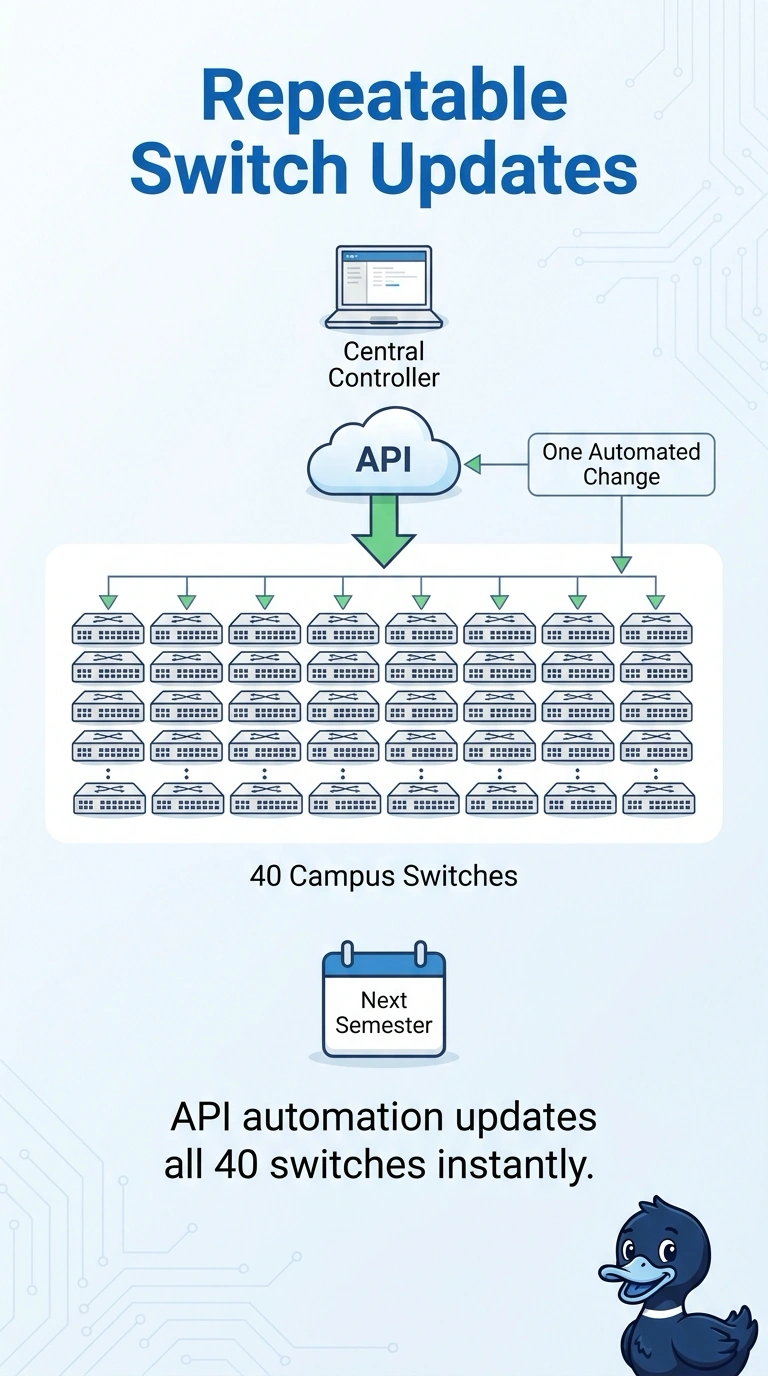
You have to hang the same sign on 40 doors, and you will do it again next semester, so walking to each door with a screwdriver is how the wording drifts. One automated call through the switches' API does the same edit everywhere. A radio survey and a one-way alarm are not how you write a VLAN description.
Full Explanation
An API lets a program read and change device state in a repeatable way. Setting one VLAN description on 40 switches, and being able to do it again next semester, is an automation job the API fits. A serial console still works when the network is down, and it does not scale to a repeated edit across 40 switches. A person retyping the change is how descriptions drift. A wireless site survey measures signal. It does not push VLAN configuration. An SNMP trap is a device-originated message, usually to UDP 162, that tells a manager something happened. The engineer does not send a trap to write a VLAN description. Exam caveat: the API still needs authentication, authorization, and change control. Automation is not a reason to skip the approved window. Operational check: run the change against a lab switch, review the result, then apply it to the 40 campus switches and confirm each running description matches the template. Log the API call and the result so next semester's run can be compared with this one.