
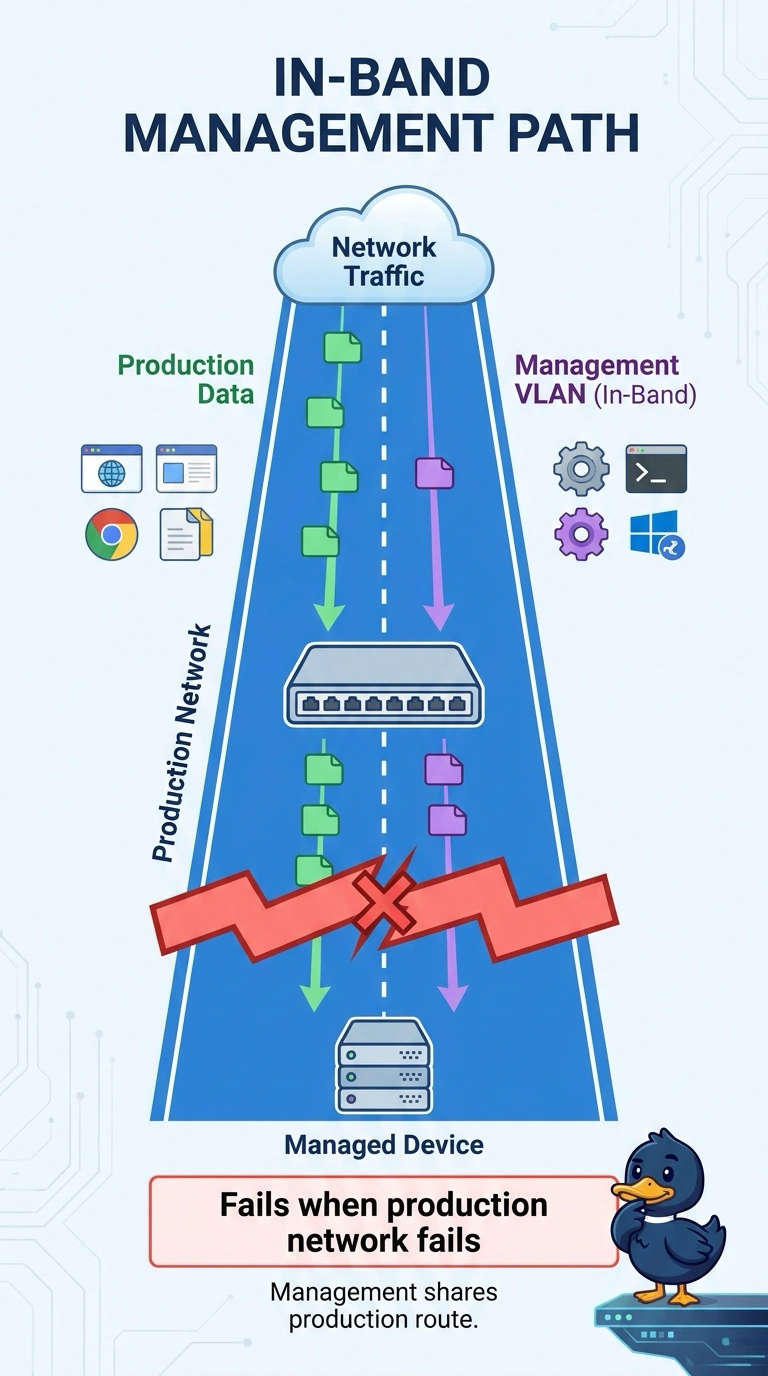
Factory engineers manage the switches through a management VLAN that rides the production network. When production routing fails, management fails with it. Which management path is that?
Select an answer to reveal the explanation.
Short Explanation
Managing the network through the same network you are trying to fix is like calling the elevator mechanic from inside the stuck elevator. You are using in-band management: the management VLAN rides production, so a production routing failure takes switch management with it. A console path, a management switch off the production routers, or a console server on its own circuit would have stayed up.
Full Explanation
In-band management uses the production network to reach the devices. The management VLAN rides that network, so when production routing fails, management fails with it. Out-of-band console access uses a path that does not depend on production forwarding. It would stay up, which is the opposite of this failure. A dedicated management switch that does not ride production routing is the tempting twin because it is also a management path. It would have stayed up when production routing failed, and this path did not. A console server on its own circuit is the same idea: a path that survives the production failure. Exam caveat: filtering the management VLAN does not make it out-of-band. If it still crosses the production routers, a routing failure still isolates it. Operational check: shut a production routing path in a maintenance window and confirm management fails with it, then reach the same switch on a console path and confirm that path stays up. Record the reading before the change and the reading after it so the next shift can see the symptom actually moved.