
The hotel front desk should learn that an uplink went down immediately, not at the next five-minute poll of the switch. Which message provides that immediate notice?
Select an answer to reveal the explanation.
Short Explanation
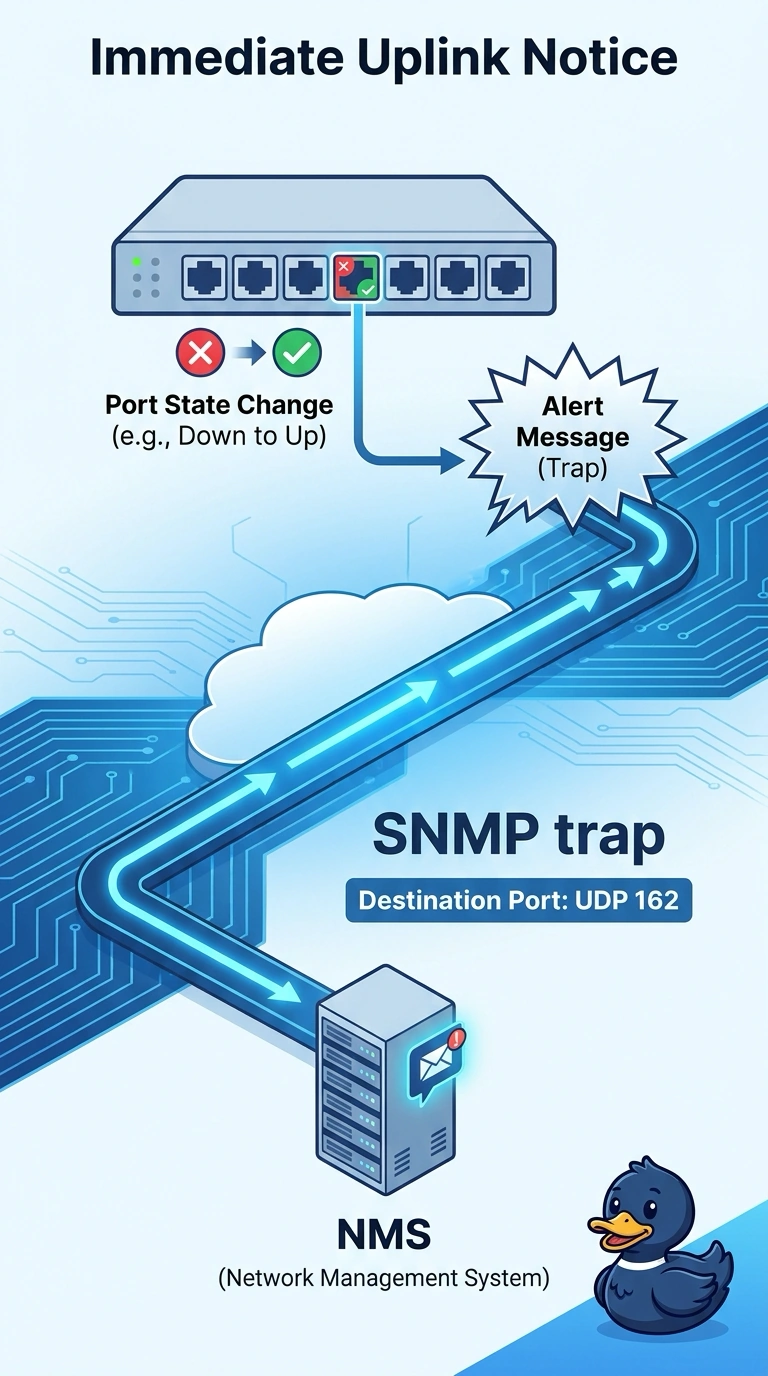
A poll is a guard walking the hall on a schedule, and a trap is the guard calling you the moment a door opens. You want the switch to send an SNMP trap to UDP 162 as soon as the uplink drops. Stretching the poll, asking again on that same poll, or sending the trap to the polling port does not give the desk that notice.
Full Explanation
SNMP polling asks the switch on a timer, so a down port can sit unnoticed until the next poll. An SNMP trap is the switch sending a message on its own, and the exam's port list assigns traps to UDP 162. That is the immediate notice the front desk asked for. A longer poll waits even more. An SNMP get on the same five-minute poll is the tempting twin because it is still SNMP and it still learns the port is down. It learns it late, which is the delay the stem rejects. A trap aimed at UDP 161 uses the port for polls, not the trap port. Exam caveat: traps use UDP, so one trap can be lost. Keep a poll as a backstop and use the trap for speed. Operational check: shut a lab port, confirm a trap arrives on UDP 162 without waiting for the five-minute poll, and confirm the alert clears when the port returns. Leave the five-minute poll in place as a backstop, and do not treat it as the immediate notice. Confirm the management station is listening on UDP 162, not only on the polling port. Restore the lab port and confirm the alert clears.