
A library mail server's outbound messages are refused because its public address has no reverse DNS. Which change addresses that refusal?
Select an answer to reveal the explanation.
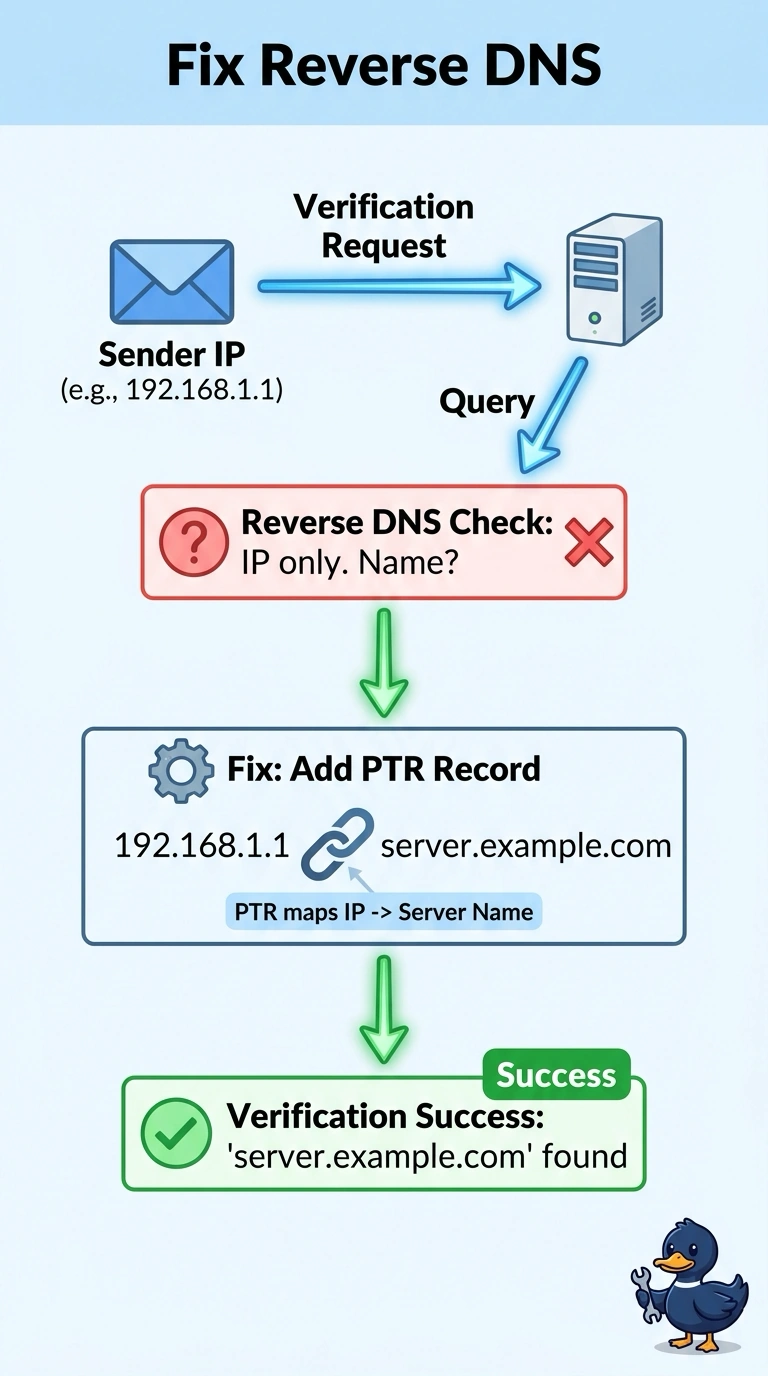
Short Explanation
Reverse DNS is the phone book sorted by number, and the other post office is checking that your number is listed. You add a PTR record for the library server's public address so the address maps back to its name. An inbound mail pointer, a forward address record, or an alias in the wrong style does not answer that reverse lookup.
Full Explanation
A PTR record maps an address to a name. Receiving mail systems look up the public address of the server that connected and refuse the message when that lookup has no answer. The missing record is a PTR for the sending address. An MX record names who receives the library's inbound mail. It does not publish the reverse of the address used to send. An A record is the near miss, because the server's name does need an address, and receivers of this mail are looking up the address, not the name. The forward record can be perfect while the reverse lookup still fails. A CNAME is an alias from one name to another. It is not the record that maps an address back to a name in the reverse zone. Exam caveat: the PTR must live in the reverse zone of whoever holds the public address, often the provider. An internal copy that the outside world never queries will not stop the refusals. Operational check: query the public address for its PTR from an outside resolver, confirm the name matches the mail server, and retry a message.