
A university requires a second location that already holds current copies of student records and can take over registration with only a short cutover. Cost is acceptable. Which recovery site matches?
Select an answer to reveal the explanation.
Short Explanation
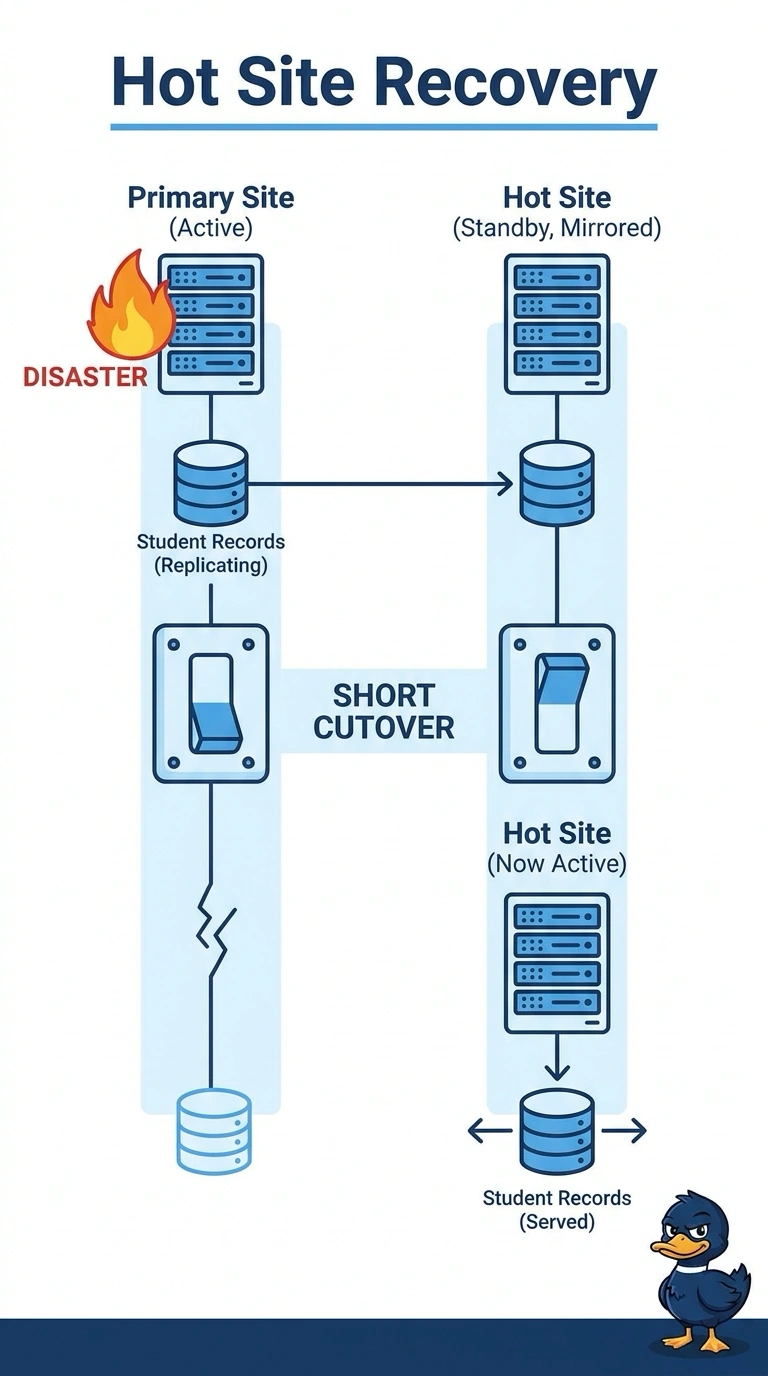
A hot site is a second building that already has today's records, not an empty room you furnish after the fire. You asked for current data and a short cutover, and that is the hot site. A warm site still has to catch up on data, and a cold site is basically a promise and a power outlet.
Full Explanation
A hot site maintains equipment and up-to-date data so production can move with a short cutover. The university's requirement, current student records already at the second location and only a brief takeover, is that definition, and the stem accepts the cost. A warm site is the near miss. It has hardware waiting, and the data is restored or caught up after the disaster, so the cutover is not short in the sense the stem requires. A cold site is space and power without the ready systems and without current data. Hardware and restores start after the disaster. An active-passive pair of devices in the same server room can fail over a chassis, and it is not a second location. A fire that takes the room takes the spare with it. Exam caveat: a hot site still has to be tested. Data that is supposed to be current can be hours behind if replication is broken, and the site is then only hot on paper. Operational check: run a cutover exercise, measure how old the student records are at the moment of the test, and confirm registration is served from the second location within the agreed window.