
A library website resolves for IPv4 clients and fails for a test client that has only IPv6. The name has an address record and no IPv6 address record. Which record should be added?
Select an answer to reveal the explanation.
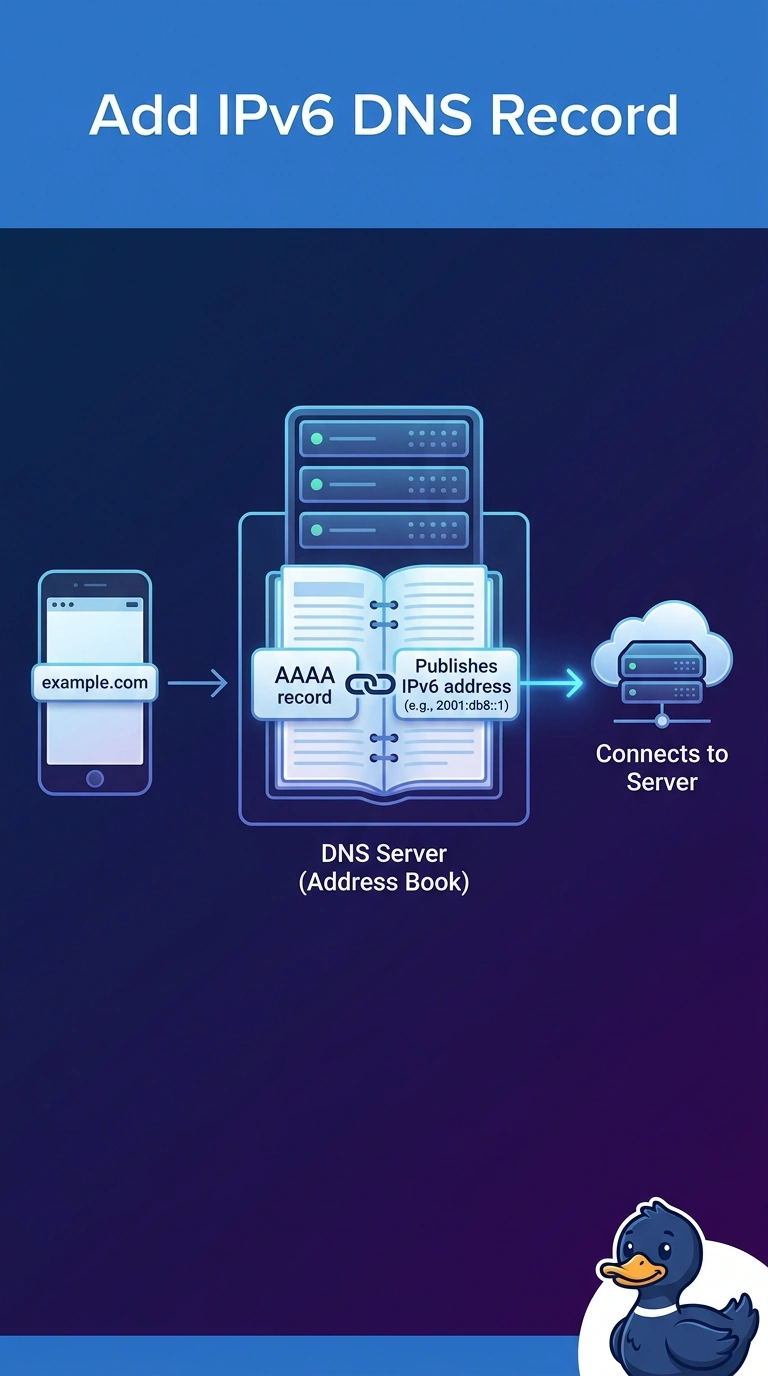
Short Explanation
An A record is the IPv4 line in the phone book, and your test client does not speak IPv4. You add an AAAA record so the same name also lists an IPv6 address. Another IPv4 address, a mail exchanger, or a reverse lookup will not give that client a number it can dial.
Full Explanation
DNS address records are specific to the address family. An A record holds an IPv4 address. An AAAA record holds an IPv6 address. The library name already has an A record, which is why IPv4 clients succeed, and it has no IPv6 address record, which is why the IPv6-only test client cannot obtain a usable address. Adding an AAAA record for the website's IPv6 address is the missing publication. A second A record only adds another IPv4 address. The IPv6-only client still receives no address it can use. An MX record identifies a host willing to accept email for a domain. The failure is a web lookup, not mail delivery, and an MX entry does not substitute for the website's own address record. A PTR record lives in the reverse zone and maps an address back to a name. It can matter for mail reputation and for verification, and it is not what a client queries when it wants the address of a website name. Exam caveat: the AAAA record must point at an address that is actually configured and routed on the web server. Publishing an unused IPv6 address makes resolution succeed and the connection fail. Operational check: query the name for the AAAA type from the IPv6-only client and confirm the answer matches the address configured on the server, then load the site over IPv6.