
Data-center administrators must open SSH to one hardened host first, and only that host may open SSH onward to the servers. Direct SSH from the internet is closed. Which design is this?
Select an answer to reveal the explanation.
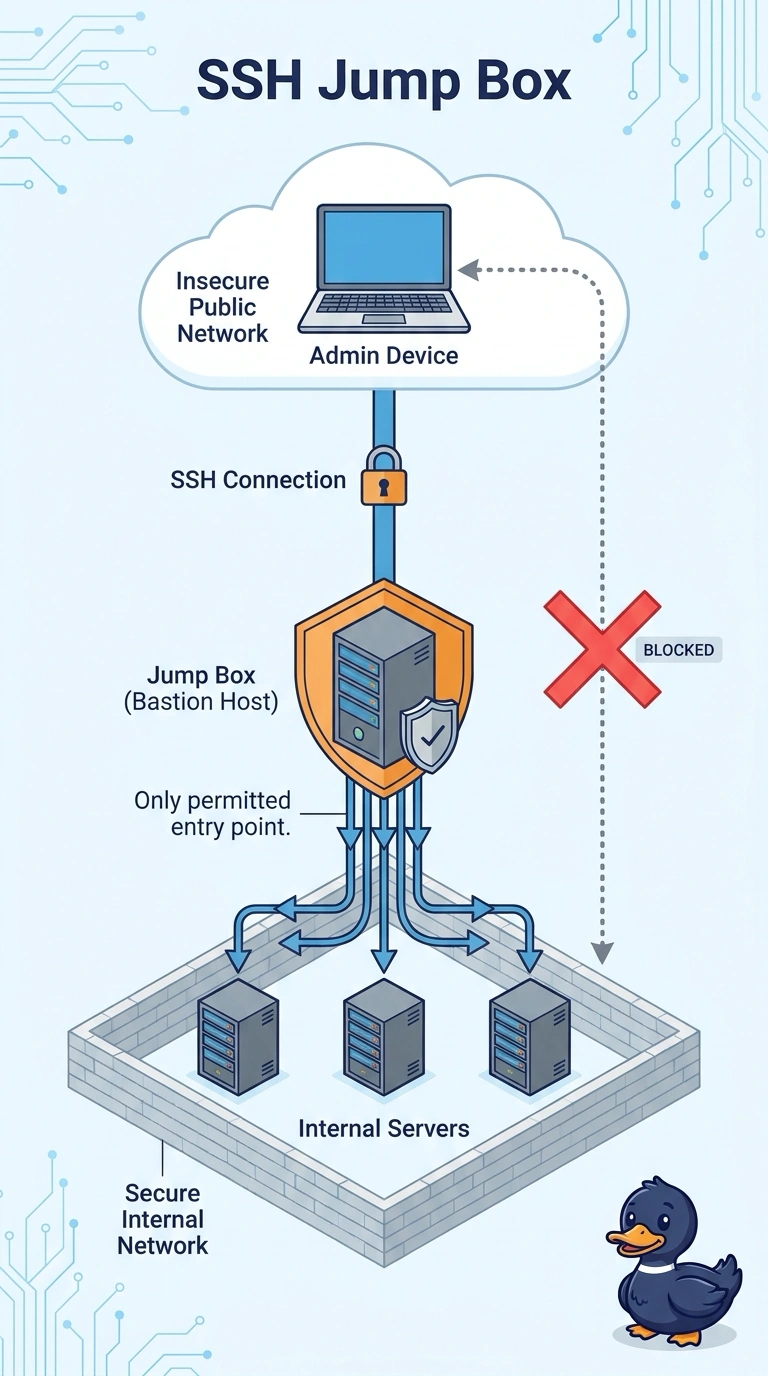
Short Explanation
You do not hand every visitor a key to every room. You make them stop at one hardened desk, a jump box, and only that desk may SSH onward to the servers. A tunnel that still lets the far side dial the servers directly, or a serial console, is a different hallway.
Full Explanation
A jump box is a hardened system that is the single SSH entry point. Administrators connect to it first. Policy allows SSH from that host to the servers and refuses SSH from the internet directly to those servers. A split tunnel sends some traffic into a VPN and lets other traffic leave locally. It does not create a mandatory SSH waypoint, and it does not close direct SSH to the servers. A site-to-site VPN is the near miss, because it also controls how an administrator reaches the data center. Once the networks are joined, any host on the far side can still open SSH unless a separate rule forces the session through one hardened host. The stem's rule is that only that host may start the server sessions. An out-of-band console reaches a management port when the network path is down. It is not the SSH relay administrators must use before they can SSH onward. Exam caveat: the jump box is only as strict as the rules around it. If the servers still accept SSH from the rest of the network, the hop is a convenience rather than a control. Operational check: from the internet, confirm SSH to a server address is refused, confirm SSH to the jump box succeeds, and from that host confirm SSH onward to a server is the path that works.