
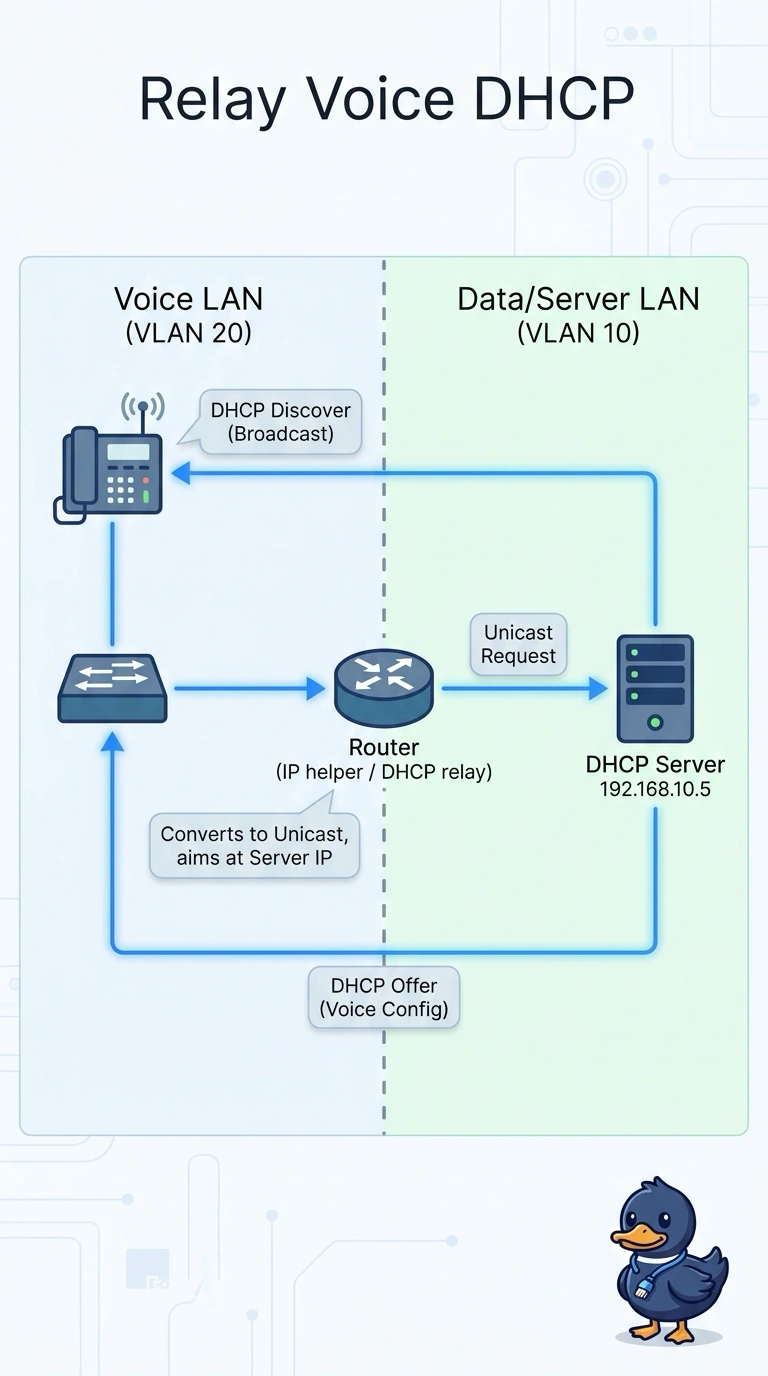
Hotel desk phones on a new voice VLAN broadcast for an address, but the only DHCP server sits on a server VLAN two hops away. The router between them is not turning that broadcast into a directed request. A scope for the voice subnet already exists on the server. Which feature must be added on that router?
Select an answer to reveal the explanation.
Short Explanation
You’ve found the missing step: a DHCP discover is a broadcast, and routers don’t forward it between VLANs. Add a DHCP relay, or IP helper, to carry the request as a directed message to the server. A duplicate voice scope, DHCP snooping, or a longer lease won’t bridge that gap.
Full Explanation
DHCP discovery starts as a broadcast, and routers do not forward broadcasts between VLANs. A DHCP relay on the router interface facing the phones accepts the broadcast, places its own interface address in the gateway field, and sends a unicast packet to the DHCP server. The server uses that field to select the voice scope, which already exists, and sends its offer back through the relay. The missing step is this conversion from broadcast to directed request, so the router needs a relay, also called an IP helper. Another copy of the voice scope does not help: the server already has the scope, but still cannot hear the phones’ broadcast. DHCP snooping can drop a rogue offer, but it does not forward the discover toward a server on another VLAN. A longer DHCP lease changes how long a client that already holds an address may keep it; a phone that has never received an address still has to reach the server. Exam caveat: the relay must point to the DHCP server’s address; a helper aimed at the wrong server will still fail. Practical check: confirm the helper address on the voice-VLAN interface, then capture traffic on the server VLAN and verify that the discover arrives as a unicast from the router and that the offer returns.