
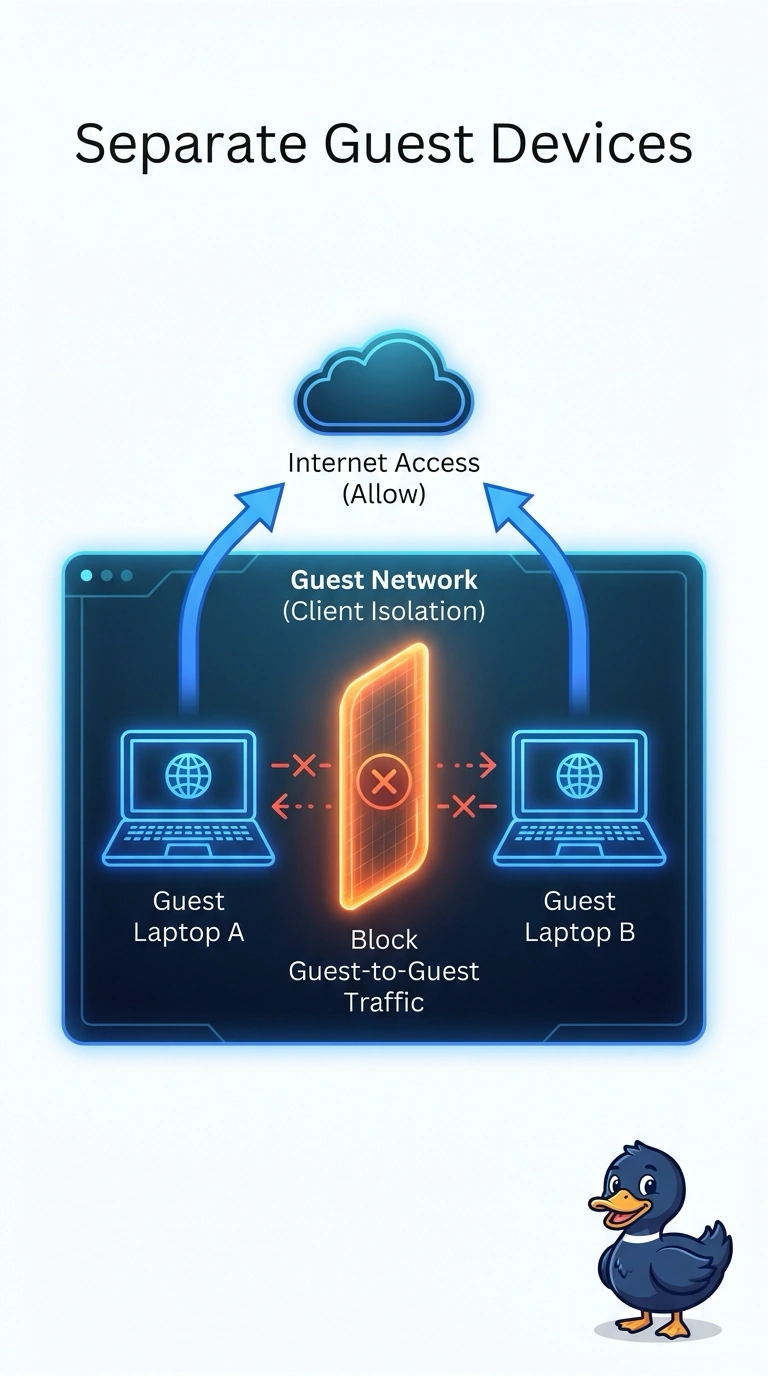
Guest laptops at a hotel must reach the internet and must not reach each other. Which wireless control enforces that separation?
Select an answer to reveal the explanation.
Short Explanation
The guests may use the lobby door to the street, and you must not let them visit each other's rooms. That rule on the wireless network is client isolation. A sign-in page, a tunnel between buildings, and a longer name on the door do not stop one laptop from talking to another.
Full Explanation
Client isolation, also called peer-to-peer blocking, stops wireless clients on the same network from forwarding traffic to each other while still allowing them upstream to the internet. The hotel wants exactly that split for guest laptops. A captive portal presents a sign-in page before access. It does not, by itself, stop two already-connected guests from reaching each other. A site-to-site VPN connects two sites. It does not isolate clients associated to the same access point. A longer SSID changes the network name. Names are not an access-control list between clients. Exam caveat: isolation on the access point does not replace a firewall rule if guests can still meet on the wired guest VLAN. Check both hops. Operational check: connect two test laptops, confirm they cannot ping each other, and confirm each can still reach the internet. From two guest laptops, confirm they cannot ping each other and can still reach the internet. Check the guest VLAN as well, because isolation on the radio does not stop two guests who meet on the wire.