
Laptops in a library must associate to an access point that is connected to the wired network. They must not talk only to each other. Which wireless mode is this?
Select an answer to reveal the explanation.
Short Explanation
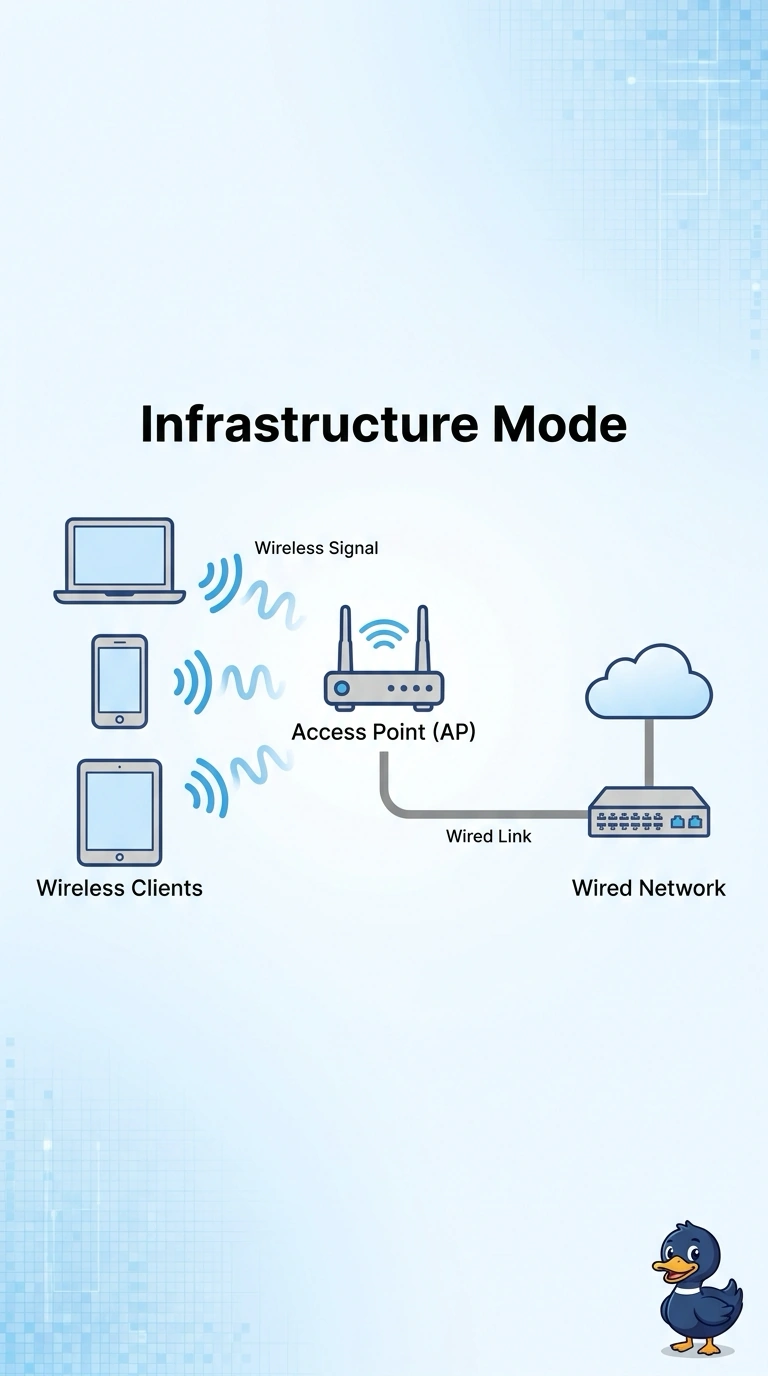
The laptops are guests of a front desk that already has a door to the building network, not a private chat among the laptops. When you associate those laptops to an access point on the wired network, you are using infrastructure mode. A peer-to-peer wireless chat, a mesh with the access point removed, or a firewall zone is a different design.
Full Explanation
Infrastructure mode is the basic service set in which clients associate to an access point and the access point connects them to the wired network. The library requires that pattern and forbids a laptop-to-laptop-only design. Ad hoc mode lets clients communicate directly without an access point. The distractor assigns ad hoc the infrastructure behavior, which reverses the two modes. A mesh extends backhaul among access points. Removing the access point would leave the laptops with no infrastructure to join, and a mesh is not what the stem describes. A screened subnet is a firewall zone, often for public servers. It is not a wireless operating mode. Exam caveat: infrastructure mode says nothing about encryption. The library still chooses WPA3 or enterprise authentication on top of this mode. Operational check: confirm each laptop's association is to the library BSSID and that the access point's Ethernet uplink reaches the wired gateway. Check the access point's association table and confirm the library laptops appear there.