
On a non-root access switch in a factory, one forwarding port is that switch's best path toward the root bridge. Which spanning-tree role is that port?
Select an answer to reveal the explanation.
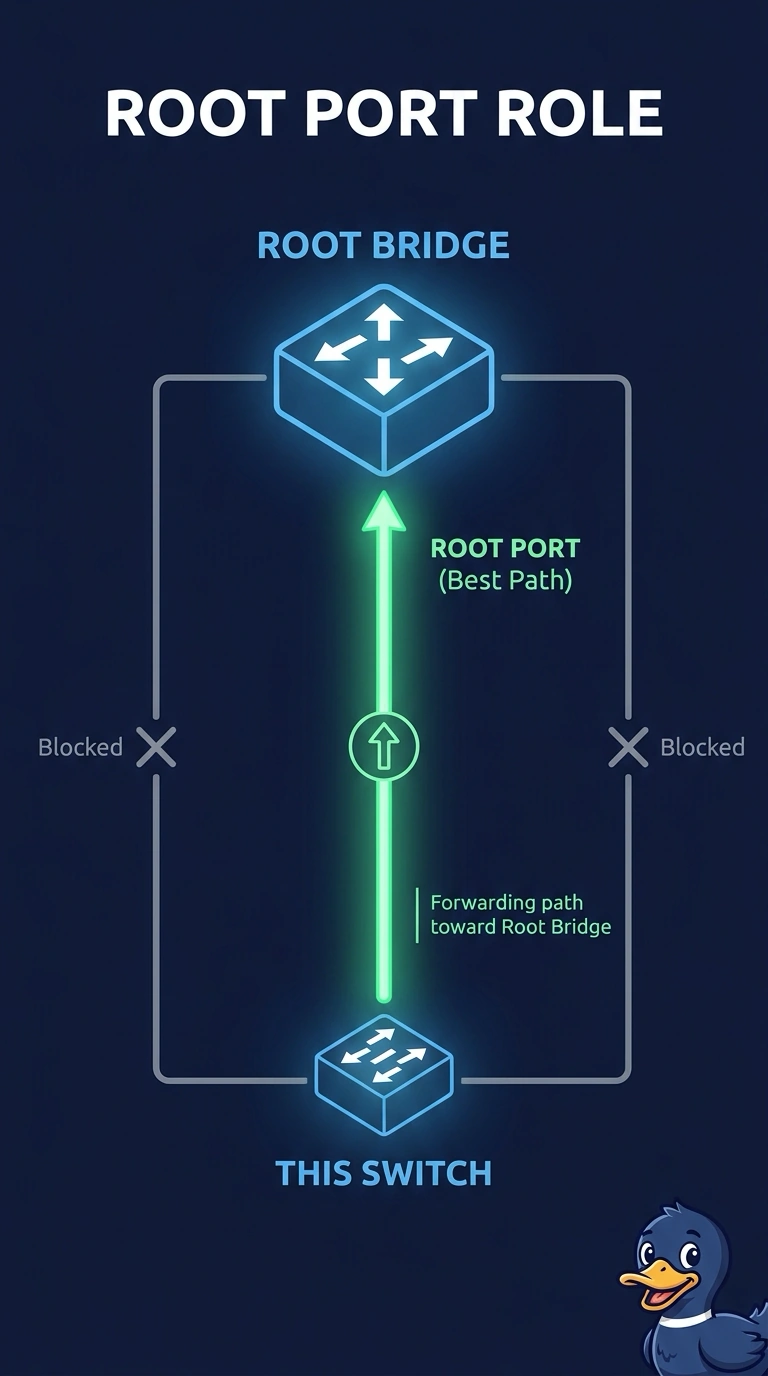
Short Explanation
Every switch except the root needs one door that faces the root, and that door is the one you leave open for traffic. That door is the root port. An alternate door stays shut, a disabled port is not in the topology, and a port on the root bridge itself is a different switch from the one in the closet.
Full Explanation
In spanning tree, each non-root switch selects one root port: the port with the best path cost toward the root bridge. That port forwards user traffic. The factory switch is not the root, and the stem describes the forwarding port that is its best path toward the root, so the role is root port. An alternate port is a backup path. In rapid spanning tree it discards frames rather than forwarding after it loses the election. A disabled port is administratively or operationally out of the topology. It is not the live path toward the root. A designated port is the forwarding port selected for a segment, and the root bridge's ports are designated, but this question is about the access switch that is not the root. Exam caveat: a designated port also forwards, so the deciding detail is whose best path toward the root the stem describes. Operational check: identify the root bridge, then on the access switch confirm the root port faces that bridge and that the other uplink is blocking or discarding.