
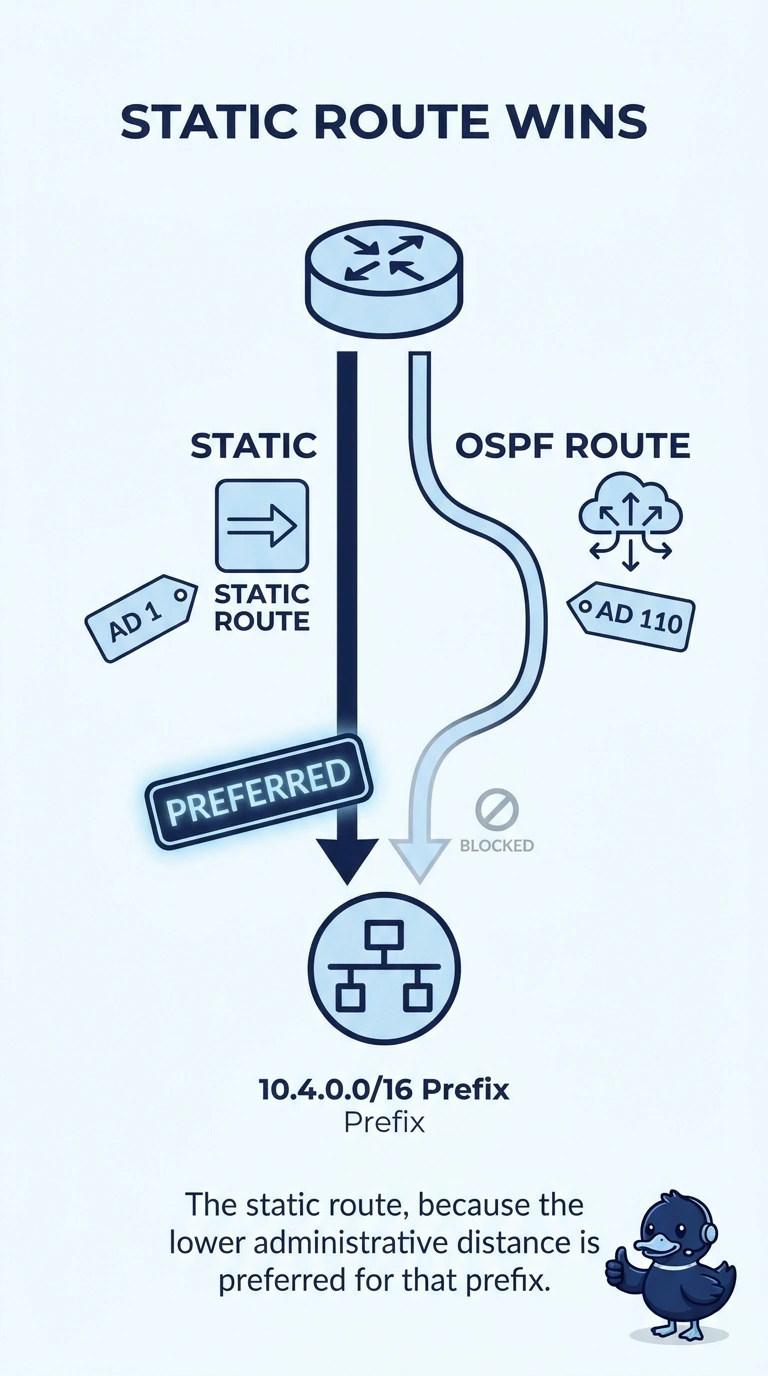
A hotel branch router shows two routes for the same 10.4.0.0/16 prefix. The static route lists administrative distance 1 and the OSPF route lists 110. Which route is installed?
Select an answer to reveal the explanation.
Short Explanation
When two routes cover the exact same prefix, you can think of administrative distance as the router's trust ranking for the source. The source with the lower number wins, so the static route at distance 1 is installed and the OSPF route at 110 stays in reserve. The trap is assuming a dynamic protocol always beats a static route, which is the opposite of how distance works.
Full Explanation
Administrative distance breaks a tie between routing sources that offer the same prefix length. The router compares the distances and installs the lower one. Here both entries are 10.4.0.0/16, the static distance is 1, and the OSPF distance is 110, so the static route goes into the routing table. OSPF does not win merely because it is dynamic. Load balancing applies when the same protocol offers equal-cost paths to the same prefix, not when two sources have different distances. If the prefix lengths were different, the longest match would be chosen before distance was considered, but this stem holds the lengths equal so distance is the deciding step. Exam caveat: a floating static is the reverse design, with a distance worse than the dynamic route so it installs only after the dynamic route disappears. Operational check: on the router, compare the prefix lengths first and then the distances, and confirm the installed route is the static entry while OSPF still knows the prefix as a candidate.