
On a warehouse switch running classic spanning tree, which port state is the one that actually forwards user frames?
Select an answer to reveal the explanation.
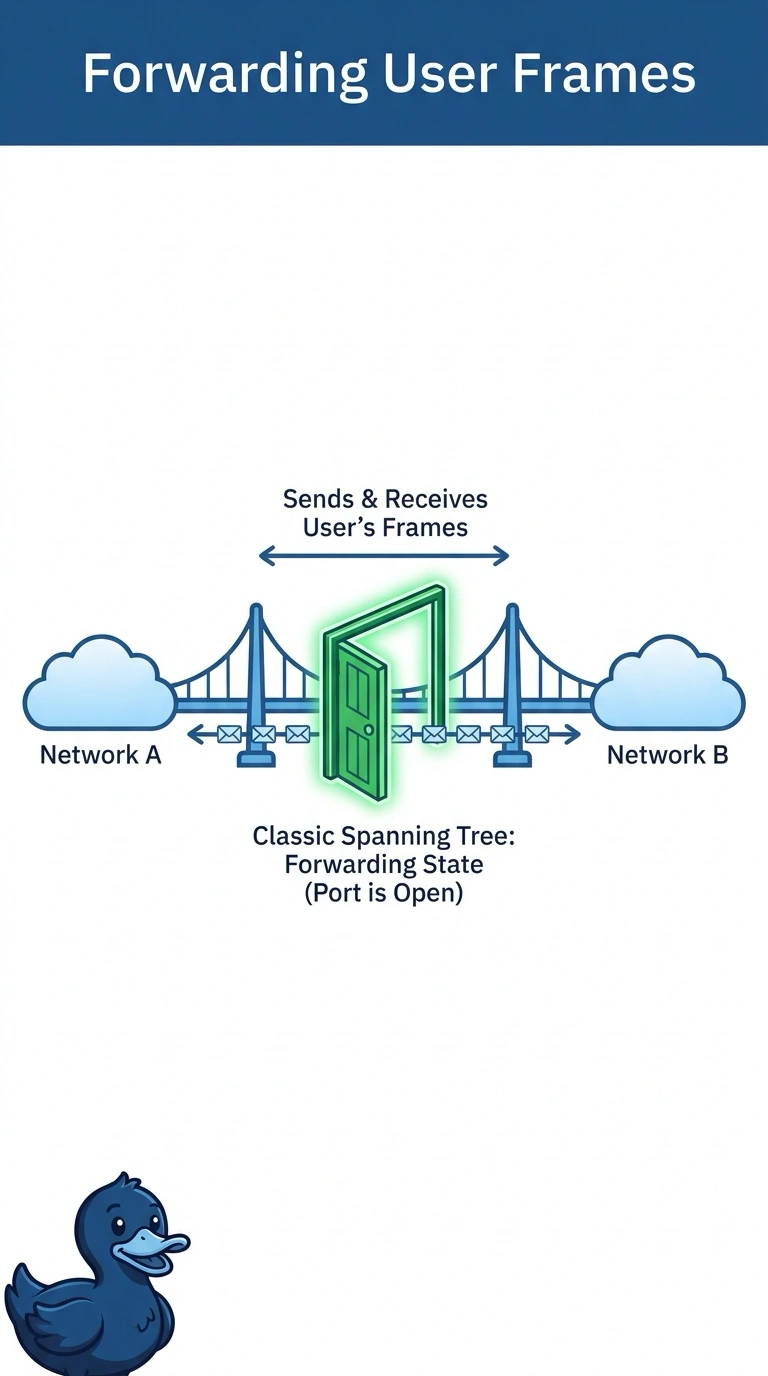
Short Explanation
A traffic light has more than one color, and only one of them means go. In classic spanning tree, the port state that actually forwards your frames is forwarding. Blocking stays out of the way, while listening and learning get ready and still do not send user data.
Full Explanation
Classic spanning tree moves a port through blocking, listening, learning, and forwarding before a formerly blocked port carries user traffic. Forwarding is the state that sends and receives user frames and also learns hardware addresses. That is the only state in the list that does the job the warehouse question asks about. Blocking receives bridge protocol data so the switch still knows the topology, and it does not forward user frames. A blocked port is how the protocol breaks a loop. Listening is a transitional state. The port prepares to participate and still does not forward user data, and it does not yet learn addresses. Learning is the next transitional state. The port records hardware addresses it hears so the table is ready, and it still does not forward user data. A port that is only learning will disappoint anyone who expects the attached PC to pass traffic. Exam caveat: rapid spanning tree shortens this sequence, and the exam item that says classic spanning tree still wants the four-state distinction. Forwarding remains the state that carries user frames. Operational check: display the port state on the warehouse switch and confirm the user's port shows forwarding before you chase a cabling fault on a port that is only listening or learning.