
A campus wants an advanced distance-vector routing protocol that can keep a backup feasible successor ready for a fast cutover. Which protocol is that?
Select an answer to reveal the explanation.
Short Explanation
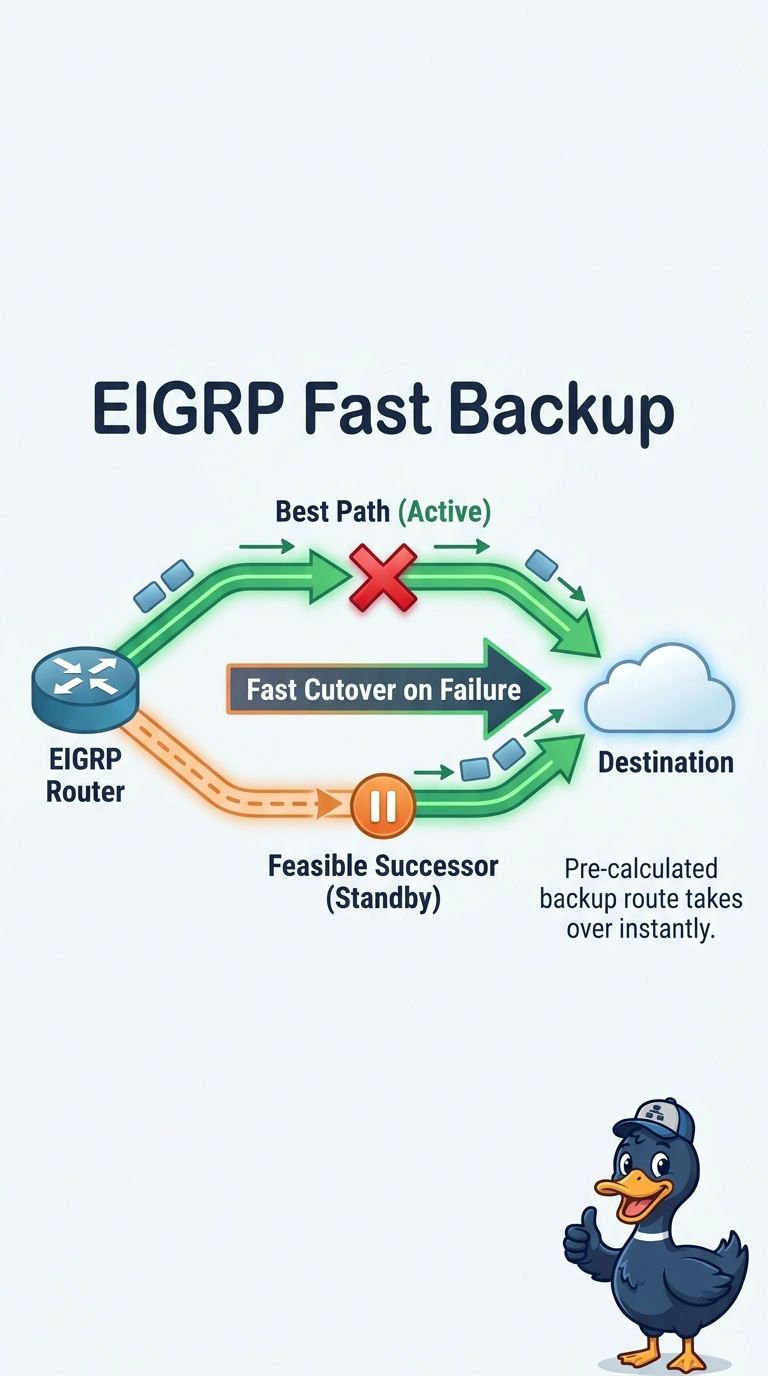
You want a backup driver already sitting in the car, not a fresh map drawn after the road closes. EIGRP is the advanced distance-vector protocol that keeps a feasible successor so the cutover can happen quickly when the best path fails. Link-state flooding, an exterior path-vector protocol, and a static route do not keep that successor.
Full Explanation
Enhanced Interior Gateway Routing Protocol is the advanced distance-vector protocol in this exam set. It advertises distances and, when a neighbor offers a loop-free backup, stores that neighbor as a feasible successor. If the successor, the best next hop, fails, the router can install the feasible successor without waiting for a full recomputation, which is the fast cutover the campus asked for. OSPF is a link-state protocol. It floods link-state advertisements and each router computes a shortest-path tree. It converges by recalculating topology, not by promoting a precomputed feasible successor, and it is not classified as advanced distance-vector. BGP is a path-vector protocol used between autonomous systems. It selects paths with policy and attributes. It is not the interior advanced distance-vector protocol, and it does not keep an EIGRP-style feasible successor. A static route is configured by hand. It has no routing neighbor, no advertisement, and no backup successor unless an administrator writes a second route with a worse preference. That second static route is not a feasible successor. Exam caveat: a feasible successor exists only when a neighbor's advertisement already qualifies as loop-free. EIGRP does not invent a backup for a prefix that has only one path. Operational check: inspect the topology table for the campus prefix, confirm a feasible successor is listed beside the successor, and fail a link to see the backup take over quickly.