
A bank complaint desk wants the phrases overdraft and insufficient funds to land near each other, because writers use them in similar sentences even though the character strings differ. Which representation places similar usage near together?
Select an answer to reveal the explanation.
Short Explanation
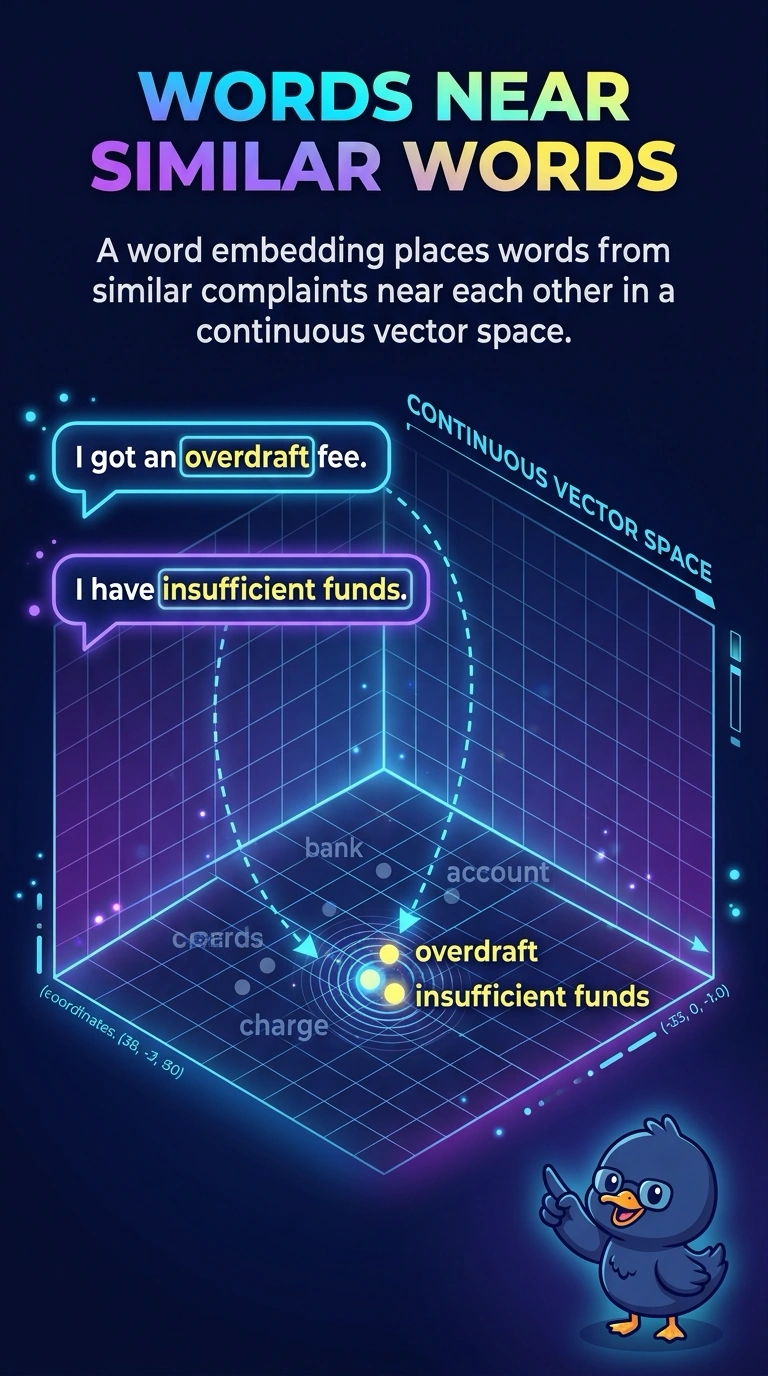
Words that hang around in the same kinds of sentences live on the same block of a map you can measure. A word embedding places overdraft near insufficient funds because their usage is similar, even though the spellings are not. The trap is edit distance, which only cares how many characters the two strings share.
Full Explanation
A word embedding assigns each word a vector so that words appearing in similar contexts lie near each other. Overdraft and insufficient funds are used in similar complaint sentences, so their vectors should be close even though the spellings share little. That is the representation the desk asked for. Edit distance measures how many character edits turn one string into the other, so dissimilar spellings stay far apart regardless of usage. TF-IDF on exact tokens gives weight to the words that actually appear and cannot place a different phrase nearby merely because writers use it the same way. A character n-gram keeps short letter sequences and responds to shared spelling, not to similar usage of different words. Exam caveat: nearness in an embedding reflects usage context, not a spelling correction, so a typo and a true synonym are not the same kind of neighbor. Operational check: retrieve the nearest neighbors of overdraft in the embedding space and confirm insufficient-funds wording sits nearby while an unrelated complaint word does not.