
A bank fills every missing applicant income with the mean of the observed incomes before fitting a model of default against income. What side effect should the team expect from that fill?
Select an answer to reveal the explanation.
Short Explanation
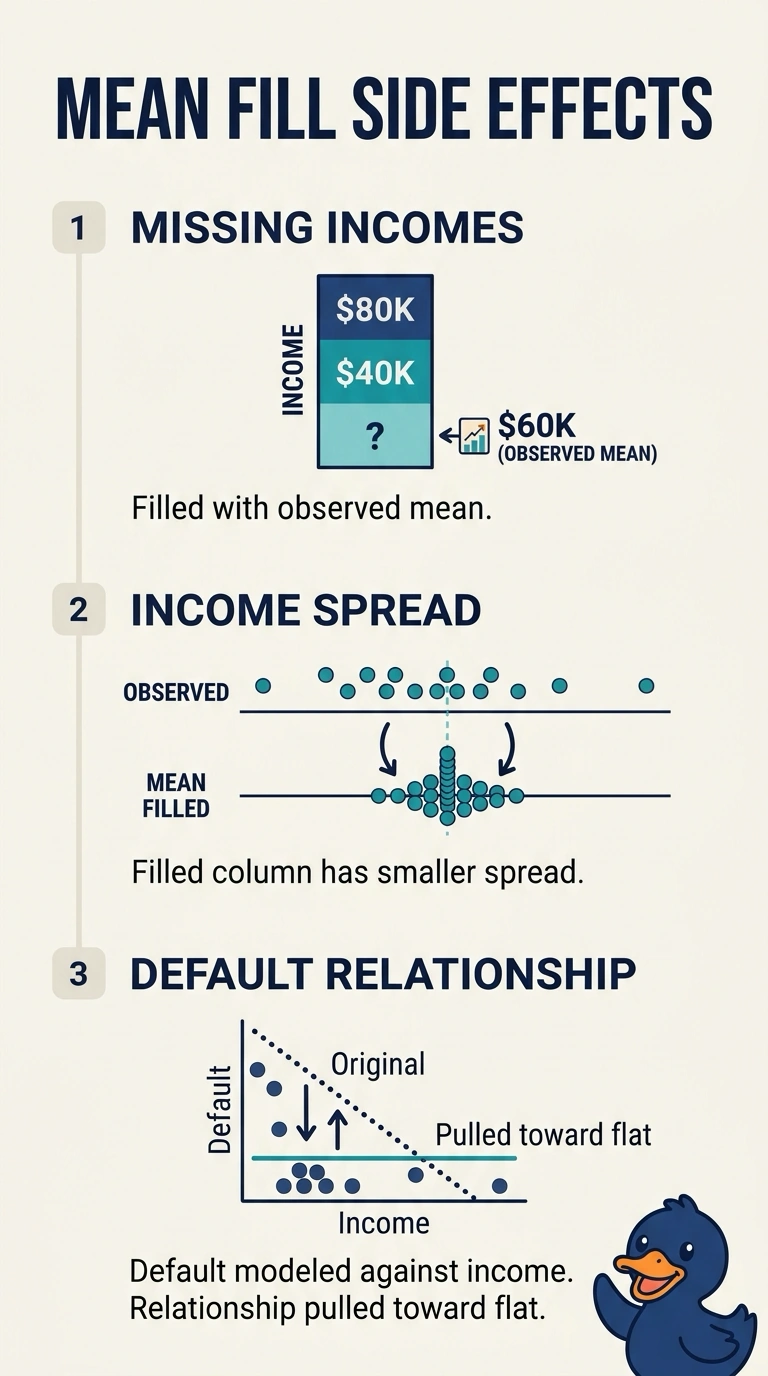
Fill every blank height on a roster with the team average and your roster looks more alike than the team really is. Mean fill shrinks the spread of income and can flatten the link to default. It does not restore the variation those missing applicants actually had.
Full Explanation
Mean imputation writes the observed average into every missing income. Those filled values sit on the mean, so they add nothing to the sum of squared deviations, while the number of rows in the variance grows. The variance of the filled column is therefore smaller than the variance of the incomes that were actually observed. When income is the predictor of default, the extra points at the mean income also add no covariance, which pulls the fitted relationship toward flat compared with the relationship in the observed pairs. Calling the edit neutral misses both the smaller spread and the attenuated slope. Saying the spread is unchanged because the sum of squares is unchanged forgets that the variance divides by a larger row count, so a constant sum of squares becomes a smaller variance, and the slope is not protected either. Saying the spread widens treats the mean as if it were a tail value, which is the opposite of where the filled points sit. Exam caveat: the damage is about the filled predictor's spread and its link to default, not a shift in the income mean; filling with the observed mean leaves that mean where it was. Operational check: compare income's variance and the fitted default slope on the originally observed rows with the same two figures after the fill, and expect the filled variance to be smaller.