
A logistics carrier still copies a trained routing model onto the scoring server by hand after each experiment. Leadership wants every build, test, and promotion to run the same way, without that manual copy. Which practice matches the request?
Select an answer to reveal the explanation.
Short Explanation
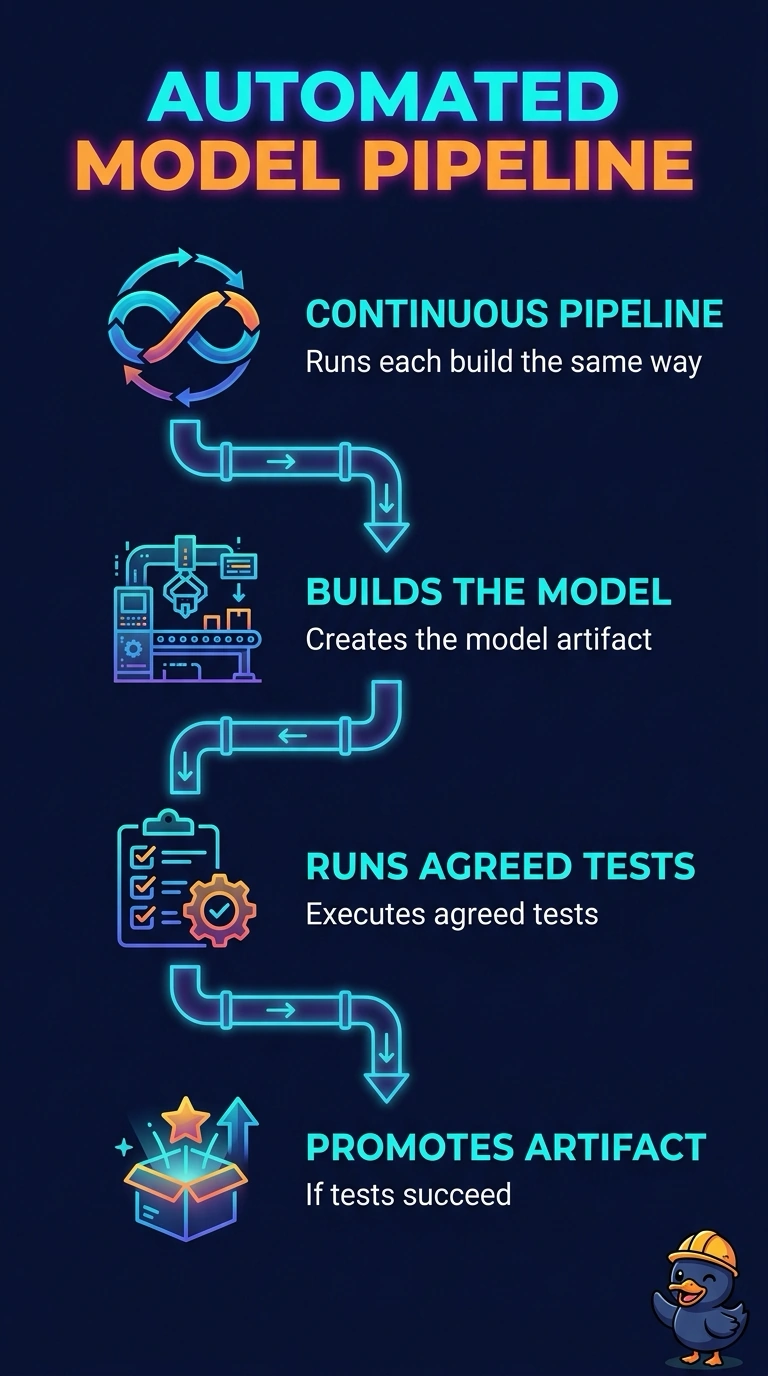
Walking a memory stick down the hall is not a release process. You want a continuous pipeline that builds the model, runs the tests, and promotes the artifact the same way each time. The trap is calling a manual copy onto the server a deployment.
Full Explanation
The request is to make build, test, and promotion a repeatable path instead of a person copying a file onto a server. A continuous pipeline checks out the training definition, builds the artifact, runs the agreed tests, and promotes that artifact only when the tests pass, so each release follows the same steps. That single definition is what the next experiment reuses, rather than a fresh set of manual instructions. A handoff by shared drive or email also skips the agreed tests, so a broken artifact can reach the scoring server with no recorded failure. A shared drive plus a weekday hand copy keeps the manual step the leadership asked to remove. A notebook emailed to an administrator is the same handoff with a different carrier; the server still receives a file a person installs. A one-time script that is deleted after use cannot build, test, and promote the next model at all. Exam caveat: a pipeline may still include a human approval click; the failure in this stem is the hand copy, not the existence of an approver. Operational check: confirm the promotion job is started by the pipeline after tests pass, and that nobody copies a weight file onto the scoring host by hand.