
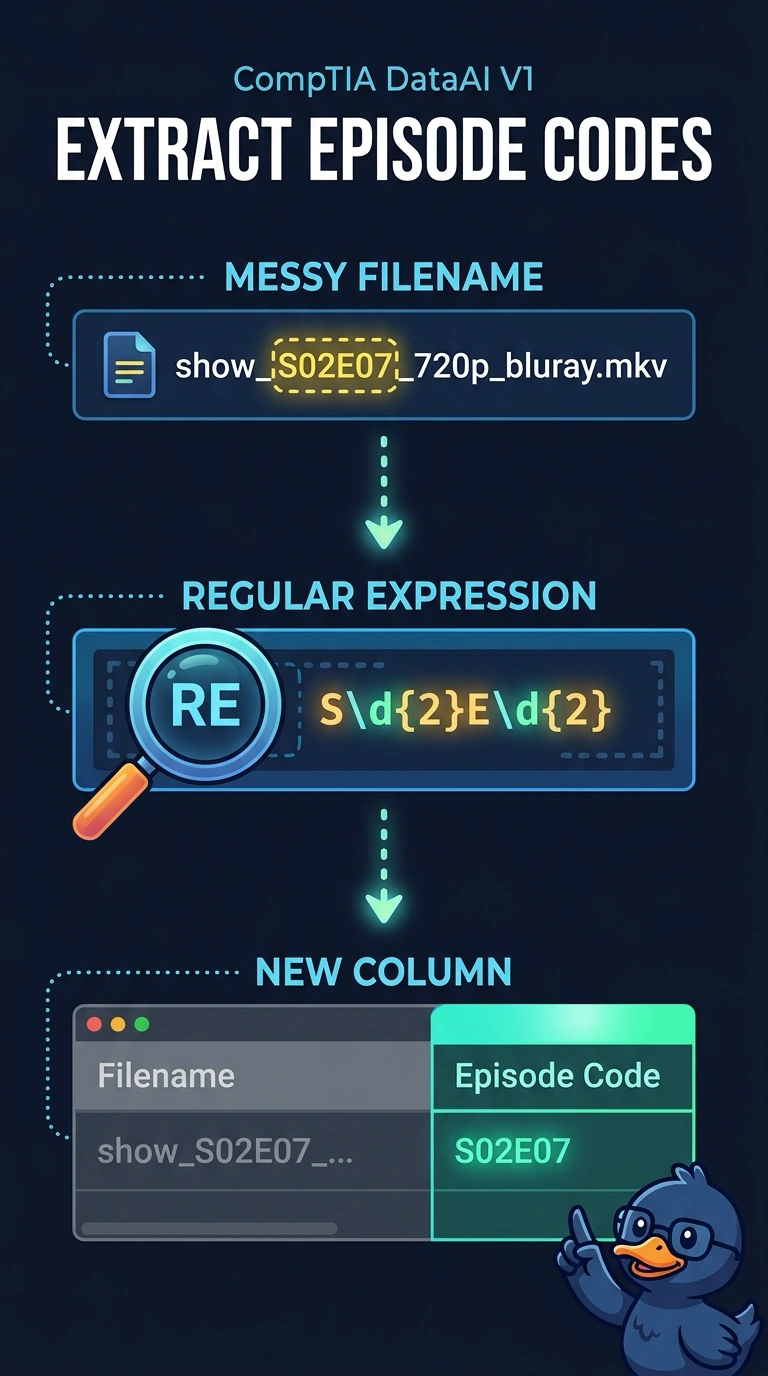
A media library stores episode filenames that mix a show title, a season-episode code such as S02E07, and a download note. Editors need that code alone in its own column. Which tool pulls the structured code out of the messy filename?
Select an answer to reveal the explanation.
Short Explanation
The code you need is a bead buried in a knot of title and notes. A regular expression is the hook that grabs the season-episode pattern and lifts it into its own column. A fuzzy link, a join on the whole filename, or a duplicate cleanup leaves the bead in the string.
Full Explanation
A regular expression describes a pattern and can capture the matching substring. The season-episode code has a stable shape inside an otherwise messy filename, so a pattern can extract that piece into a column without requiring the rest of the name to be clean. A fuzzy join scores similarity between strings in two tables; it does not by itself pull a code out of a filename, and a near title match is a different task. A left join on the full filename succeeds only when the entire messy string equals a key, which does not isolate the code. Deduplication collapses repeated filenames and leaves the surviving string intact, code and all. The pattern can let the title and the note vary, which is the point of pulling one structured piece out of messy text. Exam caveat: the pattern has to be specific enough to avoid grabbing a similar looking token in the download note, so sample filenames that contain extra digits belong in the test. Operational check: run the pattern on a filename known to contain S02E07 and confirm the new column holds that code and not the show title.