
A bank stores applicant income as 999999 whenever that field was never collected, and an analyst is about to average the income column for a credit model. What do those 999999 entries represent?
Select an answer to reveal the explanation.
Short Explanation
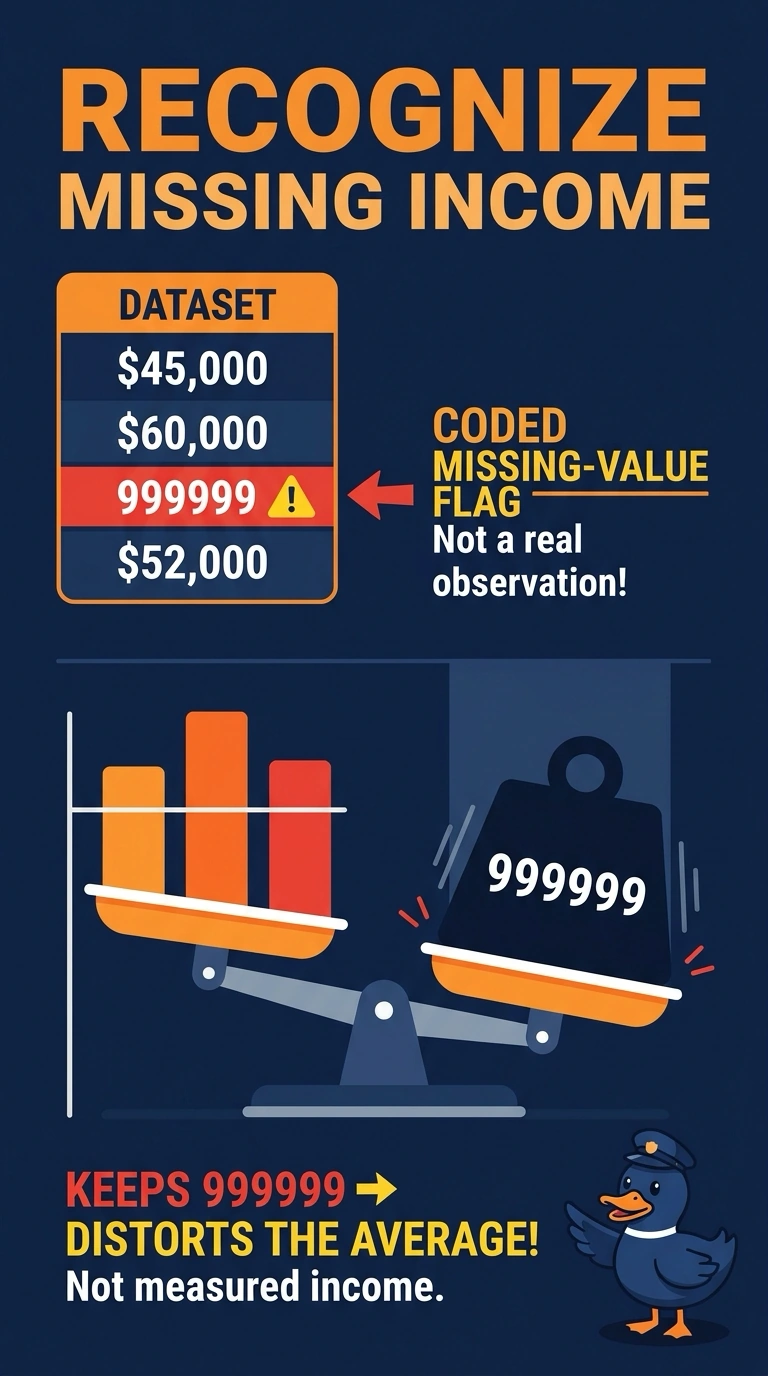
A placeholder card slipped into a stack of paystubs is not itself a paycheck. Those coded entries mark incomes that were never collected, so you would distort the average by treating them as real dollars. Do not let a numeric look convince you the flag is a measurement.
Full Explanation
A sentinel is a reserved code that means the measurement was not taken. Here 999999 was written exactly when income was never collected, so those cells are flags, not pay amounts. Leaving them in the average treats a placeholder as a huge salary and pulls the typical income far above the applicants who actually reported earnings. Reading the code as a genuine high salary contradicts the collection rule in the file. Reading it as zero earnings invents a real measurement the applicant did not provide; missing is not the same as earning nothing. Reading it as a product salary cap also contradicts the stem, which ties the code to a field that was never collected rather than to a true income that hit a ceiling. Exam caveat: a sentinel only works if you know the code; a real applicant could in principle earn an unusual amount, so the codebook, not the size of the number, decides. Operational check: count how many incomes equal the flag, confirm each one matches the never-collected rule, and recompute the average after those rows are marked missing.