
A telecom call-center application needs a churn score while the agent is on the phone, and the training code must stay in the data lab. How should the application obtain the score?
Select an answer to reveal the explanation.
Short Explanation
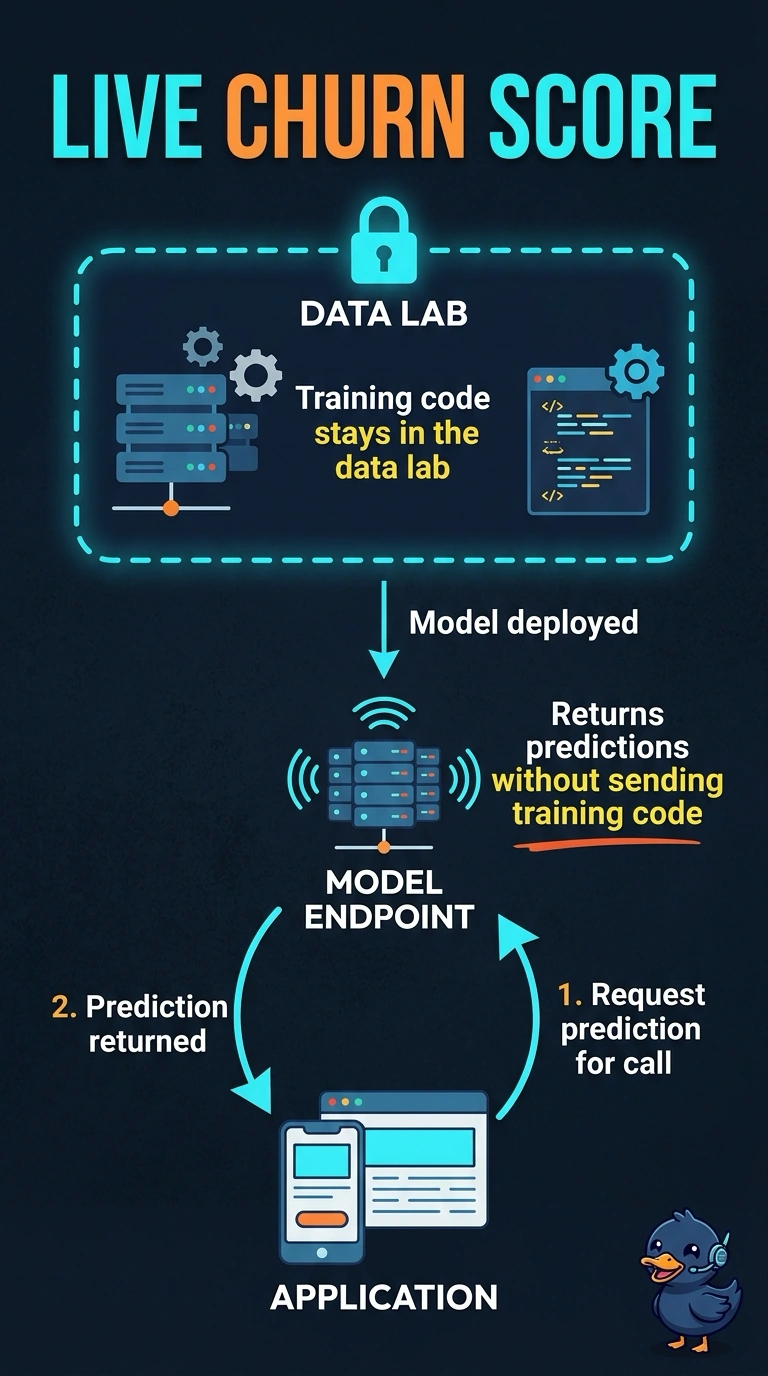
You want the score handed through a service window, not the whole kitchen shipped to the call center. A model endpoint returns the prediction while the training code stays in the lab. Copying the notebook onto each computer is the move that breaks that split.
Full Explanation
A model endpoint exposes a trained model as a service: the application sends the features it has for this caller and receives a prediction, while the training code remains in the lab. That split is what the call center needs during a live call. Copying the training notebook onto each agent's computer ships the training process out of the lab and asks the PC to refit during the call. Pasting the training rows into the application repository does the same kind of damage by moving the fit into the app. A slide of last month's accuracy is an evaluation summary, not a score for the customer on the phone. The lab keeps the fitting code, the training rows, and the training job. The call center only needs a number for the person on the line, and the endpoint is the boundary that hands over that number. Refitting on the agent's machine would also be too slow for a live call, and it would scatter training copies the requirement said must stay in the lab. Exam caveat: the endpoint serves inference, so it does not replace the lab's training pipeline; it assumes a model has already been trained and published. Operational check: place one live-call request against the endpoint and confirm a churn score comes back while the training code stays only on the lab side.