
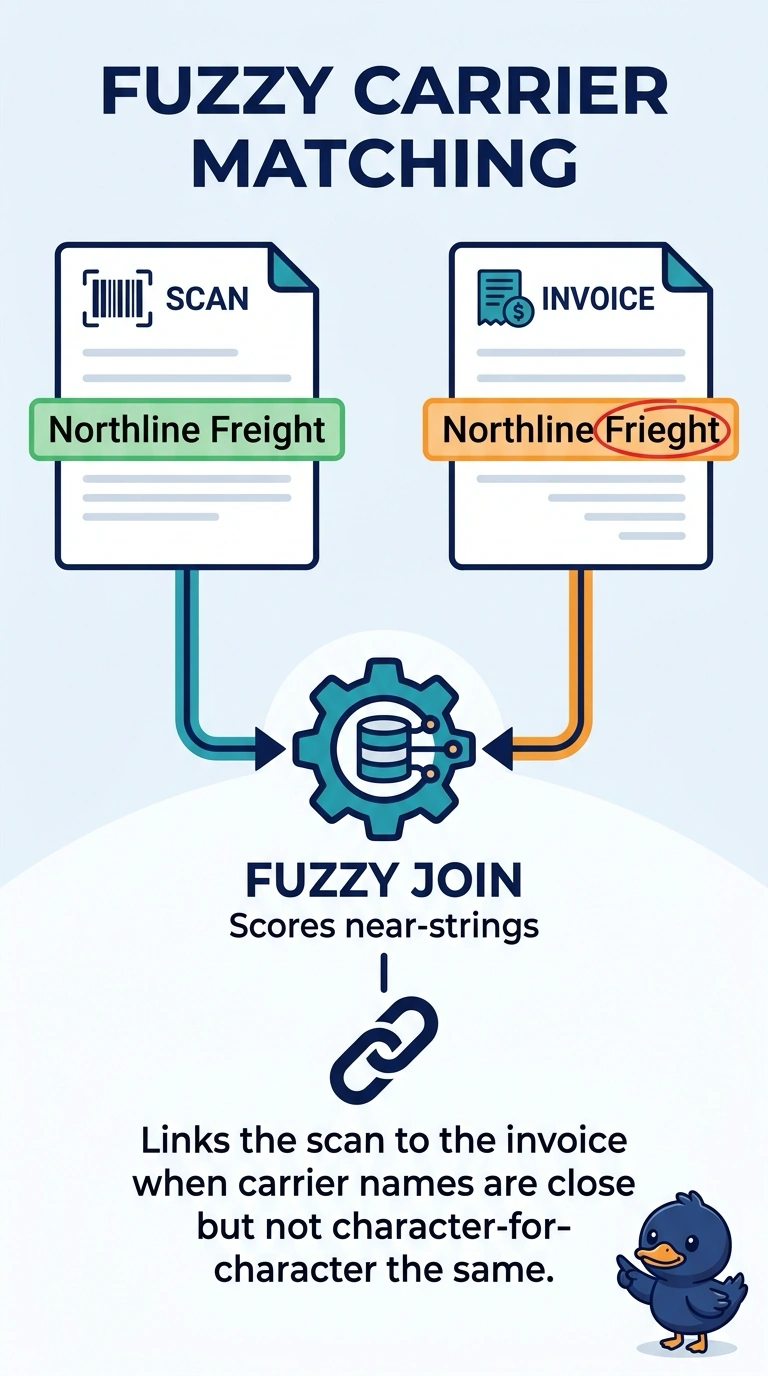
A logistics desk must link shipment scans to carrier invoices. A scan names the carrier Northline Freight while the invoice says Northline Frieght, so an exact key match drops the pair. Which join still links those two records?
Select an answer to reveal the explanation.
Short Explanation
You are matching nicknames, not checking a serial number stamped the same way on both forms. One misspelled letter makes an exact key miss the carrier, even though a person can see it is the same firm. A fuzzy join is what still pairs those near-strings.
Full Explanation
A fuzzy join compares strings that are not identical and links rows when the names are close enough under a similarity score. Northline Freight and Northline Frieght differ by a transposition, so they fail an equality test and pass a near-string test. An inner join on the raw name keeps a pair only when the characters match exactly, which is the match that already dropped this invoice. A left join can keep the unmatched scan in the output, but it still attaches an invoice only on an exact name, so the misspelled pair remains unlinked. A cross join filtered to equal names multiplies rows and then applies the same exact test, so the spelling difference still removes the pair. The similarity score belongs on the carrier name itself, not on the whole invoice line, or an unrelated token can create a false link. Exam caveat: a fuzzy link can attach the wrong carrier when two real names are similar, so the score needs a review threshold the desk chooses. Operational check: take a sample of pairs the exact join dropped and confirm the fuzzy score links the Freight and Frieght rows to each other.