
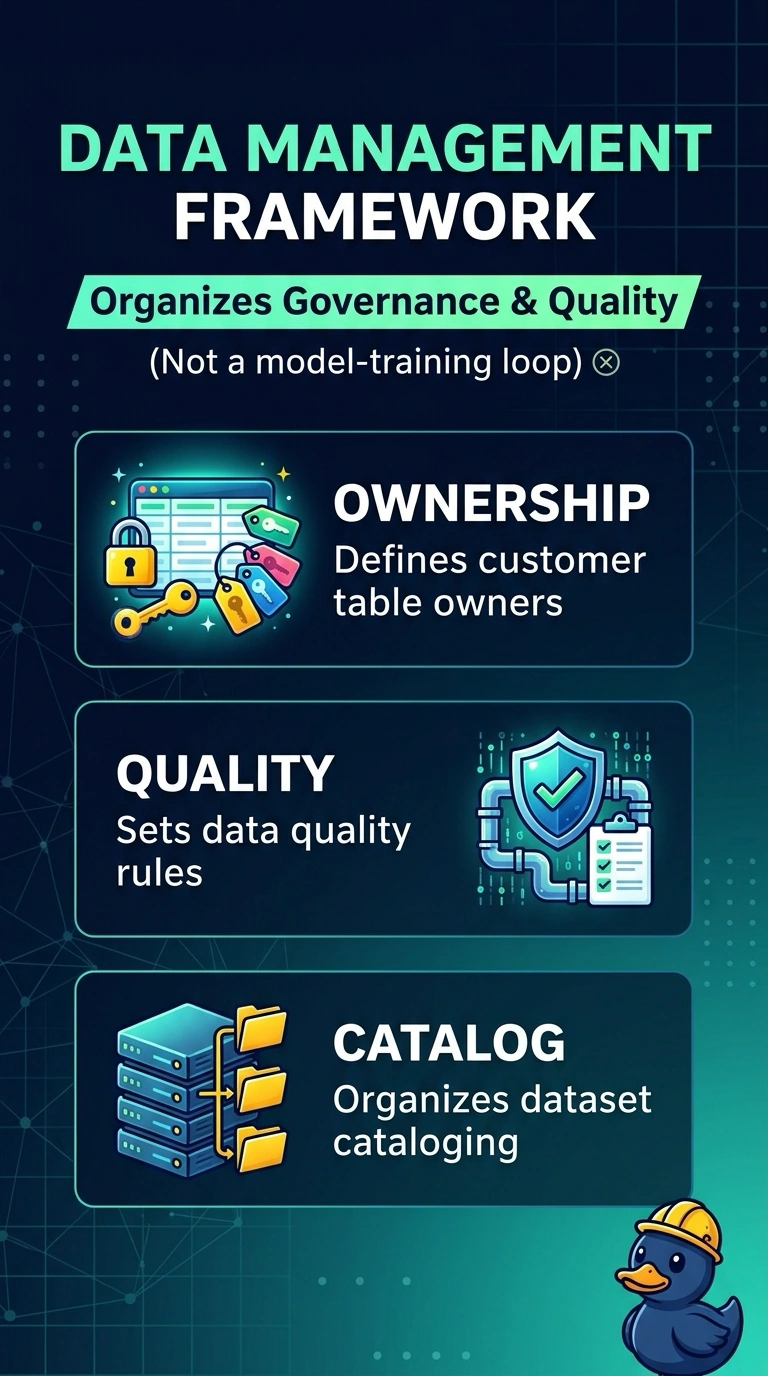
A bank needs a standing structure for who owns customer tables, which quality rules apply, and how datasets are cataloged. A teammate hears that request as another round of model training. Which description fits the request?
Select an answer to reveal the explanation.
Short Explanation
A library catalog tells you who owns each shelf and what condition the books are in. It does not retrain the librarian. A data-management framework organizes governance and quality, and the trap is hearing that request as another training loop.
Full Explanation
A data-management framework is the standing structure for data as an asset: ownership, quality rules, definitions, and a catalog of datasets. The bank asked who owns the customer tables, which quality rules apply, and how datasets are cataloged. That is governance and quality management, and it is not a pass of model training. Another model-training loop refits weights on folds or new samples and does not assign table owners or publish quality rules. A hyperparameter search tunes a learner's settings and never catalogs datasets or names stewards. A scoring endpoint serves predictions to applications after a model exists, and it does not define ownership or quality rules for source tables. Exam caveat: a modeling project may consume governed data, but the framework that governs the data is not the same loop that fits the model. Operational check: look for a named steward, a written quality rule, and a catalog entry for a customer table, and confirm none of those artifacts is a training log.