
A news publisher fit a revenue model only on weeks whose ad spend stayed inside a familiar band. Editors now want a forecast for a spend far above every week in that fit. What is the problem with using the model there?
Select an answer to reveal the explanation.
Short Explanation
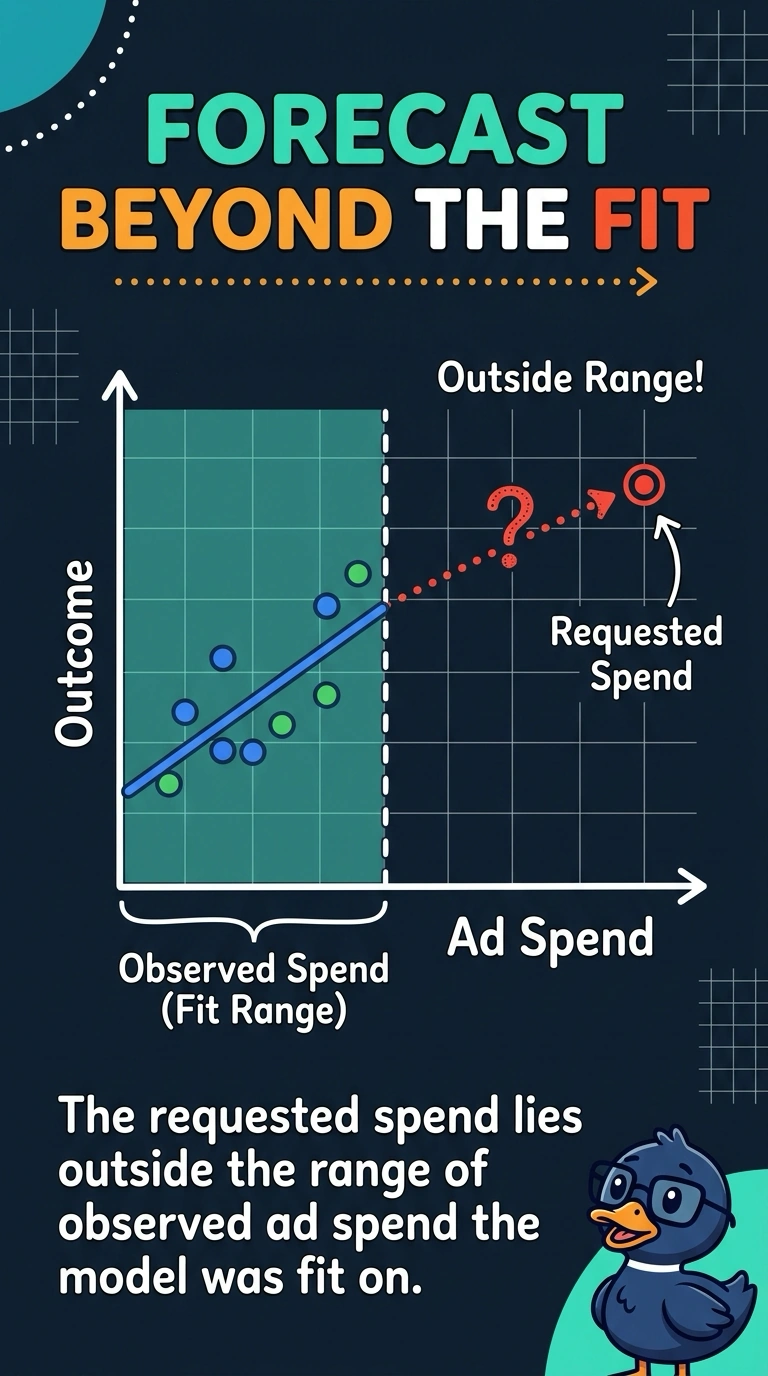
A model is a map of the spend levels you actually measured, and a spend the publisher has never run sits off that map. The trap is thinking that filling in the same features keeps the forecast inside the relevant range. You should treat this ask as outside the range the model was fit on.
Full Explanation
The revenue model was estimated only on weeks inside a familiar band of ad spend, so that band is the relevant range where the fitted relationship has been observed. A requested spend above every week in the fit is outside that range, and the model is being asked to speak where its relationship was not estimated. Filling in the same feature names does not keep the forecast inside the relevant range, because the range is about the levels of those inputs, not about which columns are present. The problem is also not limited to linear models: a more flexible fit can bend sharply outside the observed band and is not automatically trustworthy at a spend the publisher has never run. The relevant range is not the set of dates after deployment. A future week can still sit outside the range if its spend is unlike the spends used to fit the model, and a past week inside the band would still be in range. Exam caveat: being outside the relevant range does not prove the forecast is numerically impossible, but it does mean the fitted relationship is no longer supported by the estimation data. Operational check: compare the requested spend with the minimum and maximum spend in the fitting weeks and flag the forecast when it falls outside that band.