
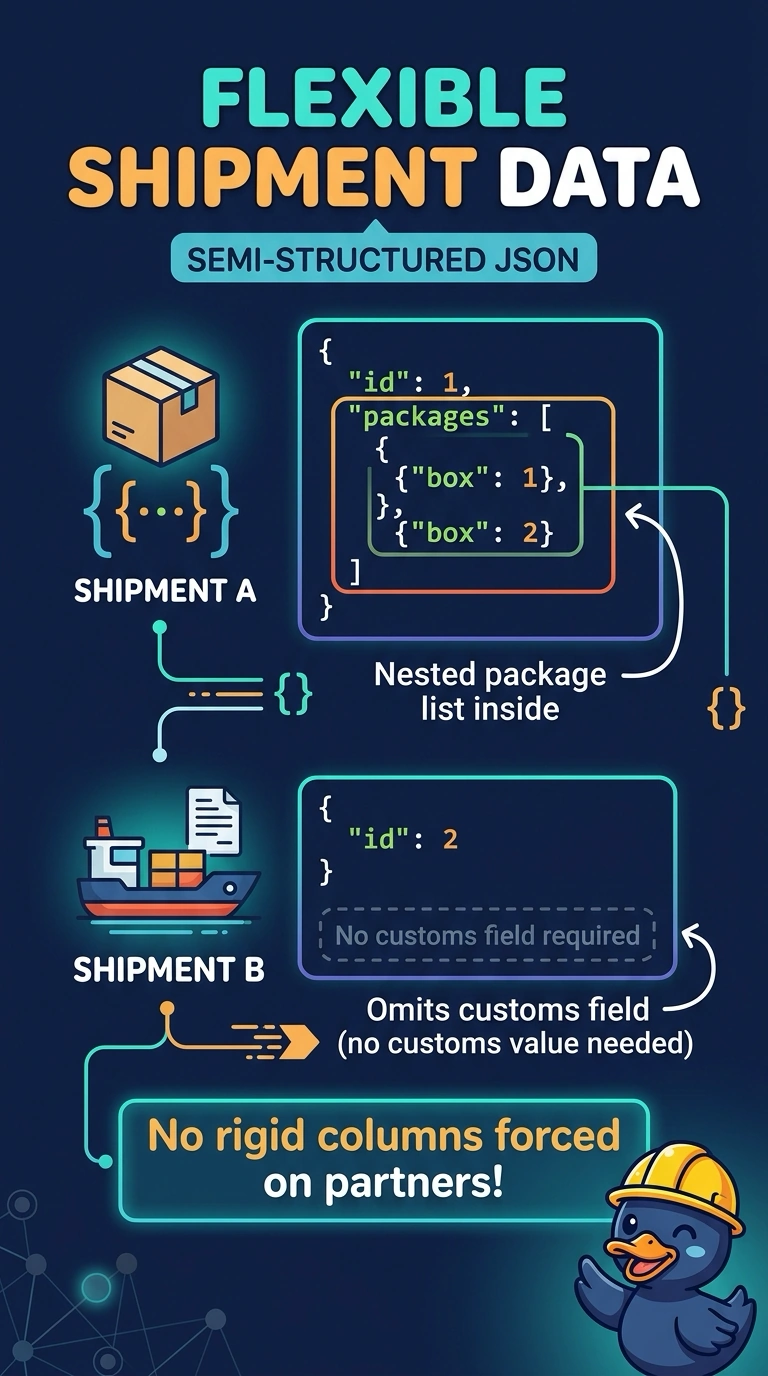
A logistics carrier receives shipment messages from many partners. Some messages nest a list of packages inside the shipment, and some omit the customs field entirely. The team needs a format that keeps both of those differences. Which description fits that format?
Select an answer to reveal the explanation.
Short Explanation
Picture a paper form that lets you tuck a package list inside the shipment box and leave the customs line blank. JSON is semi-structured in that same way: records may nest, and a field may be absent. The trap is a rigid row that demands the same filled columns on every shipment.
Full Explanation
JSON is semi-structured: one shipment object can contain a nested array of packages, and a partner that has nothing to declare can leave the customs field out of that object entirely. The records do not have to share one identical set of populated columns. A relational table with a single required column list does the opposite, demanding the same fields on every row, including a customs value the partner never sent. An unstructured text blob can store the raw message, but a nested package list is not exposed as addressable fields. A fixed-width file reserves the same slots on every record, so a missing customs value is padded into place rather than omitted, and a nested list has nowhere to grow. Exam caveat: semi-structured does not mean the payload has no structure; it means the structure is allowed to vary from record to record, including nested values and absent fields. Operational check: open two raw messages side by side, confirm one contains a package array and no customs field, and confirm the stored JSON keeps that nesting and that omission.