
A freight carrier can keep a simple route-time model or pay to run a much heavier model that cuts a little error. The money saved by that smaller error is less than the heavier model's operating cost. Which choice follows from the comparison?
Select an answer to reveal the explanation.
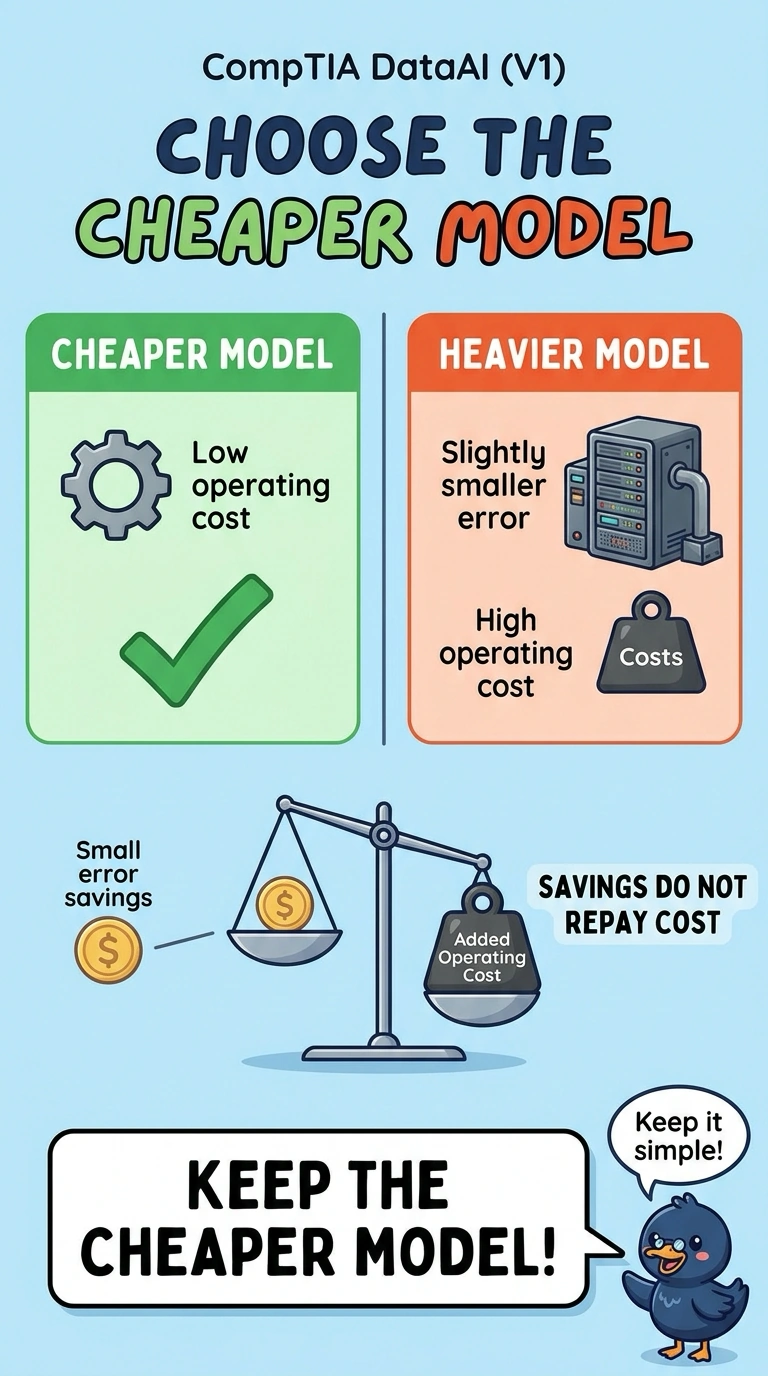
Short Explanation
If a fancier model saves you less money than it costs to run, a smaller error is not a reason to buy it. The trap is treating any accuracy gain as worth the price, or averaging models and hoping the cost goes away. Keep the cheaper model when the expensive improvement does not pay for itself.
Full Explanation
The comparison already prices both sides: the heavier model reduces error, but the money that reduction saves is smaller than the cost of running the heavier model. On that cost-benefit comparison the cheaper model is the one to keep, because the added accuracy does not pay for itself. Buying the heavier model would treat a smaller error as the objective even when the savings fail to cover the operating cost, which ignores the comparison the carrier just made. A lower error on the routes used to fit the model is a training result, not the cash difference between savings and operating cost, so it does not answer this decision. Averaging the predictions still requires running the heavier model, so it does not split away the operating cost, and it changes the prediction rule rather than following the cost comparison. Exam caveat: a later change in error cost or in computing price can flip the comparison, so the choice is tied to the costs in hand, not to a permanent ranking of the two models. Operational check: put the estimated savings from the error reduction and the heavier model's operating cost on the same time window and keep the cheaper model when savings are smaller.