
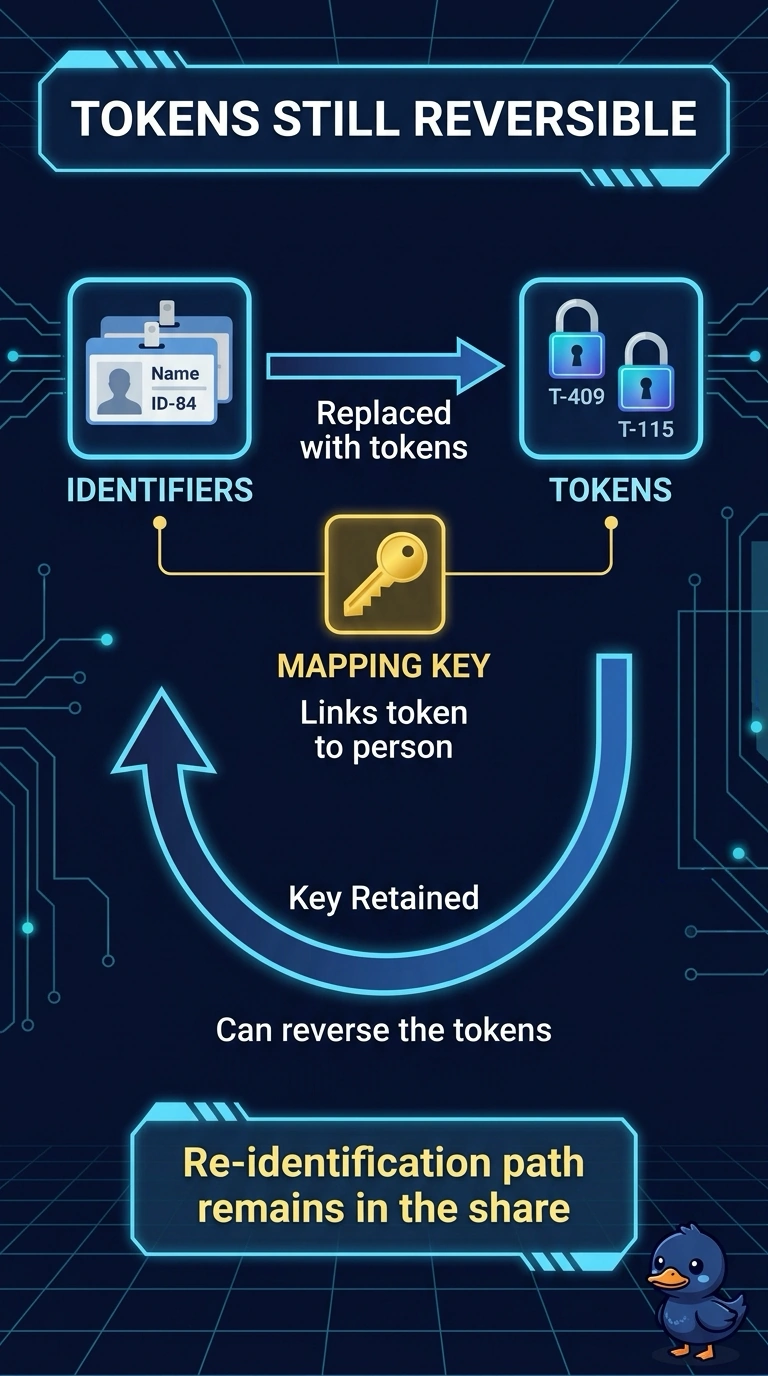
A telecom team replaces subscriber identifiers with tokens before a data share, and it keeps the key that maps every token back to a person. What is still true of that share?
Select an answer to reveal the explanation.
Short Explanation
A costume is not a disappearance if you still hold the zipper. You kept a key that turns every token back into a subscriber, so the re-identification path is still there. Do not confuse that reversible obfuscation with a share nobody can tie to a person.
Full Explanation
Replacing identifiers with tokens hides them only from a reader who lacks the mapping. The telecom team kept the key that maps every token back to a person, so anyone who obtains the key, or any process that uses it, can reverse the share. The re-identification path is intact; the file is obfuscated, not stripped of a way back. A table with no visible names is not anonymous while a stored key still joins tokens to people. Treating obfuscation and removal of re-identification as the same control ignores that difference and would wrongly clear the file for a public posting. The token step also does not delete the original identifiers in the system that stores the key; that system is the path. Exam caveat: reversible tokens can still be useful inside a tight access boundary, but usefulness is not the same as removing the path back to a person. Operational check: locate every copy of the mapping key, confirm the shared file can be joined back to subscribers with it, and do not describe the share as free of re-identification while that key exists.