
A hospital screen flags patients for a rapid-response review. Missing a true deterioration costs far more than an extra review, yet the team ranks candidate models by accuracy because accuracy is the notebook default. Which metric choice fits this decision?
Select an answer to reveal the explanation.
Short Explanation
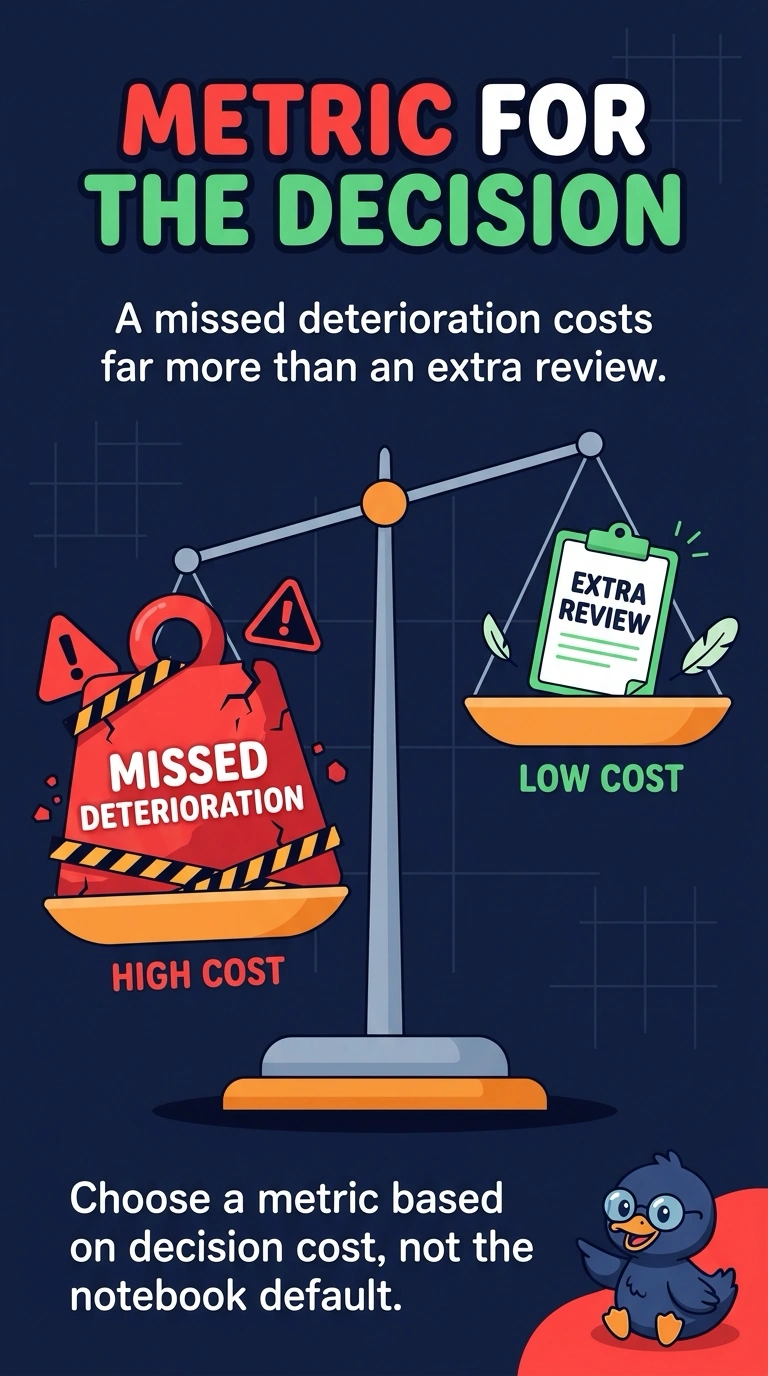
You’re right to look past the notebook default: a missed deterioration costs far more than an extra review. Choose a cost-matched metric that gives the miss greater weight, rather than treating both errors equally as accuracy does.
Full Explanation
A missed deterioration costs far more than an unnecessary review, so the model-ranking metric should reflect that imbalance. Choose a metric that weighs a missed deterioration more heavily than an extra review; this aligns model selection with the hospital’s decision, rather than with the notebook’s default. Accuracy counts each patient error once, treating a miss and an extra review as equal, so keeping accuracy as the ranking measure does not represent the stated costs. Selecting whichever metric is cheapest to compute prioritizes computational convenience, and the rule gives no assurance that missed deteriorations receive greater weight. Maximizing accuracy on the training census has the same equal-error problem and also makes a training result stand in for the score used at the review desk. Exam caveat: even a cost-matched metric does not by itself determine how many patients will be flagged; the operating threshold must still be workable for the review team. Practical check: before ranking models, write down the relative cost of a missed deterioration and an extra review, confirm the chosen metric reflects that relationship, and ensure accuracy is not being used as the ranking column by default.