
A public-health agency plans to rank restaurants for inspection. The team is ready to spend a week tuning hyperparameters, but nobody has written which inspection decision the ranking must support. What should happen before that tuning week?
Select an answer to reveal the explanation.
Short Explanation
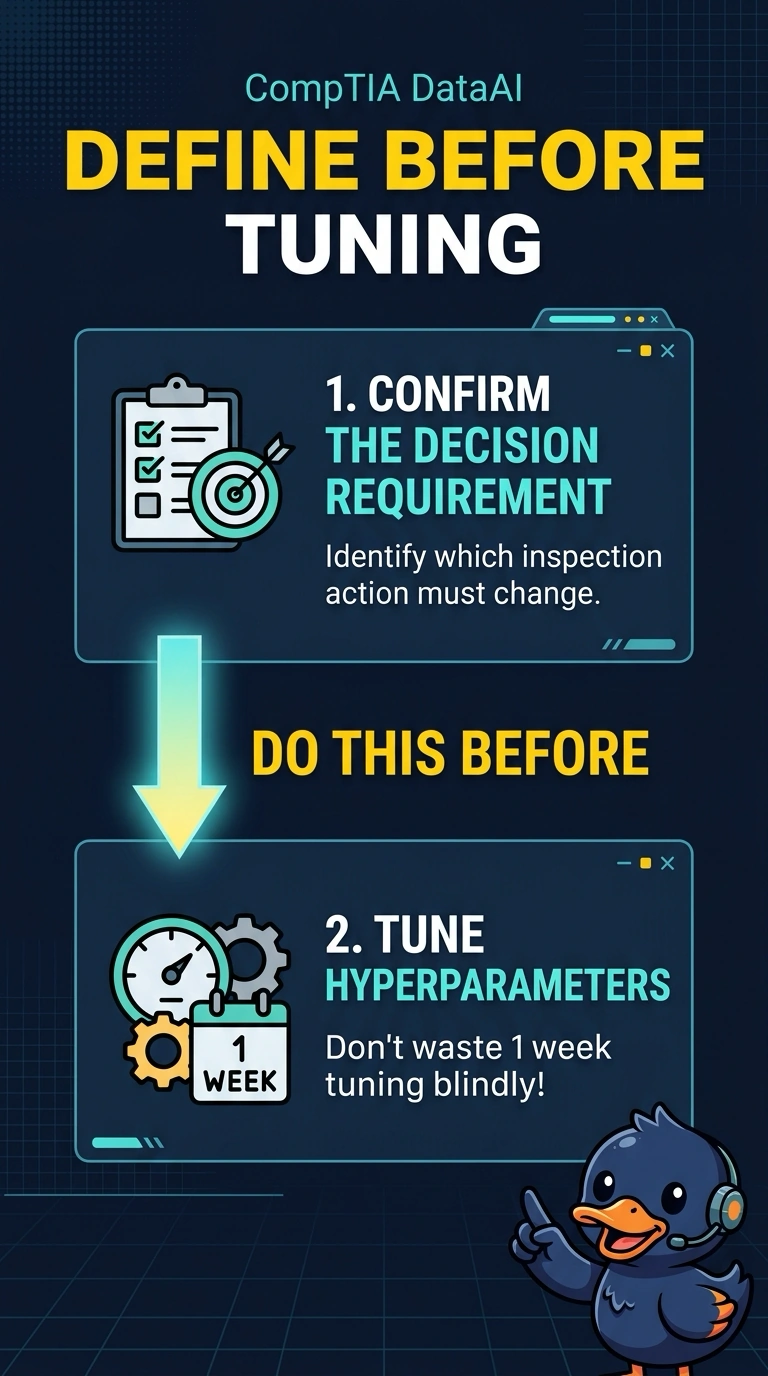
You are about to spend a week seasoning a dish nobody has ordered. Write down the inspection decision this ranking must drive before you touch hyperparameters. A wide grid, a frozen metric, or a lower training loss will not tell you what the inspectors needed.
Full Explanation
Hyperparameter search improves a model against a metric. If the agency has not stated which inspection action the ranking must change, the search has no decision to serve and a week of tuning can optimize the wrong use. The requirement comes first: what the inspector will do with the rank, and which constraint makes a ranking useful. Inferring the requirement from whichever setting wins lets the grid choose the question. Freezing a metric and a family before talking with inspectors can lock in a ranking that does not match the visits they can staff. Optimizing training loss assumes a lower loss becomes a usable schedule, which need not be true if the loss ignores travel time, staffing, or the inspections that matter. Exam caveat: the requirement is the decision and its constraint, not a request to skip measurement; once the action is clear, a metric can be chosen and then tuned. Operational check: write the inspection action the rank must change, and have an inspector confirm that sentence before the search is started.