
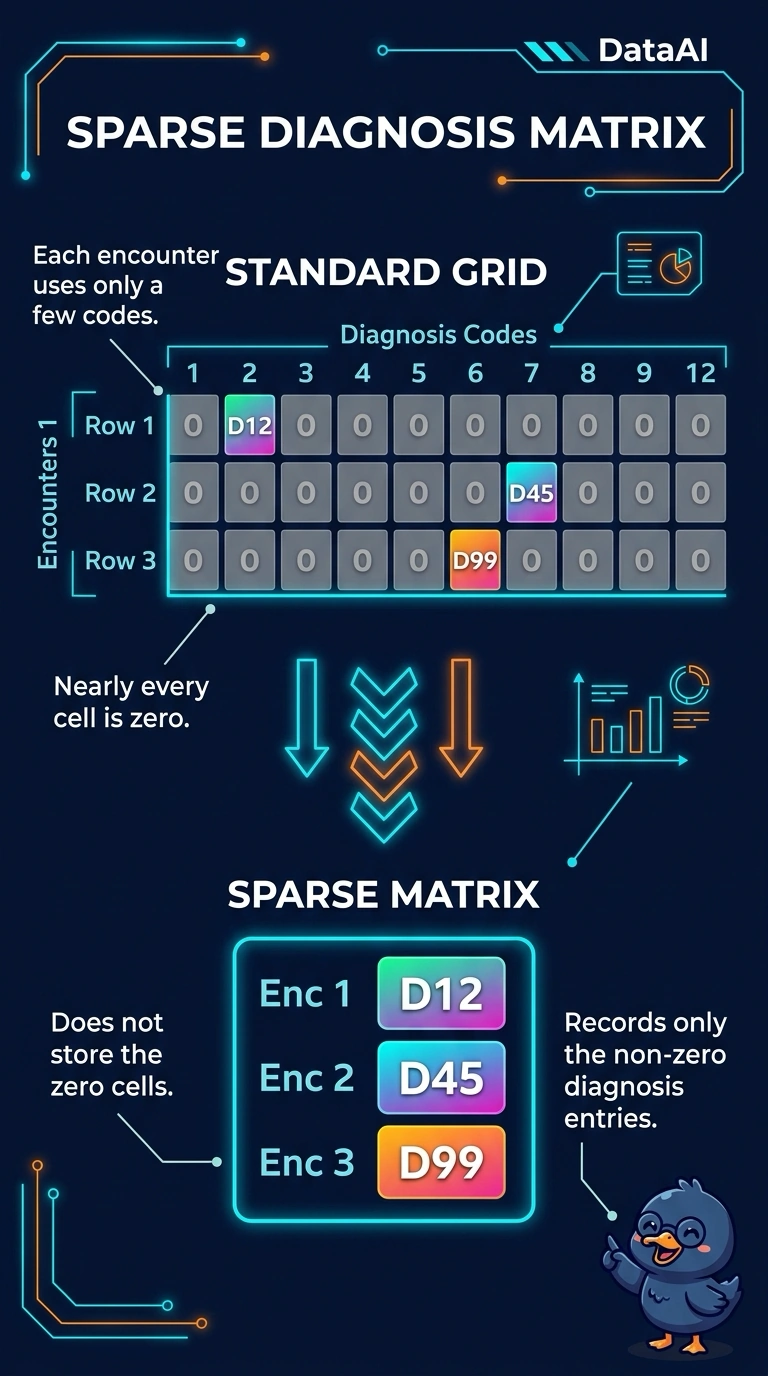
A hospital builds a matrix with a row per encounter and a column per diagnosis code. Nearly every cell is zero, because each encounter uses only a few codes, and storing every zero wastes space. Which storage approach fits this matrix?
Select an answer to reveal the explanation.
Short Explanation
A pantry list that writes down only the jars you actually have wastes no ink on empty spaces. A sparse matrix stores only the non-zero diagnosis entries and skips the zeros that dominate this table. The trap is rewriting a dense table more often and hoping the zeros somehow stop taking space.
Full Explanation
A sparse matrix stores the row, column, and value of each non-zero entry and omits the zeros. In a diagnosis-by-encounter matrix, almost every code is absent from a given encounter, so storing only the codes that occurred removes the wasted zero cells. A dense matrix writes every cell, so the zeros still occupy space. The space saved by a sparse layout is exactly those zero cells that were never written, while the diagnosis codes that did occur stay available. Refreshing that dense table more often rewrites the same zeros; cadence does not change which cells are stored. Dropping rarely used codes, or keeping only rows that are mostly filled, changes which encounters and codes exist in the data and still does not define sparse storage of the remaining zeros. Exam caveat: sparse storage is about omitting zero entries, not about whether the codes themselves are rare in the hospital overall. Operational check: count stored entries against rows times columns and confirm the stored count equals the number of non-zero diagnosis cells, not the full rectangle.