
A bank models daily ATM cash demand. One term multiplies yesterday's demand by a coefficient, using the series' own past level rather than yesterday's forecast error. What is that term?
Select an answer to reveal the explanation.
Short Explanation
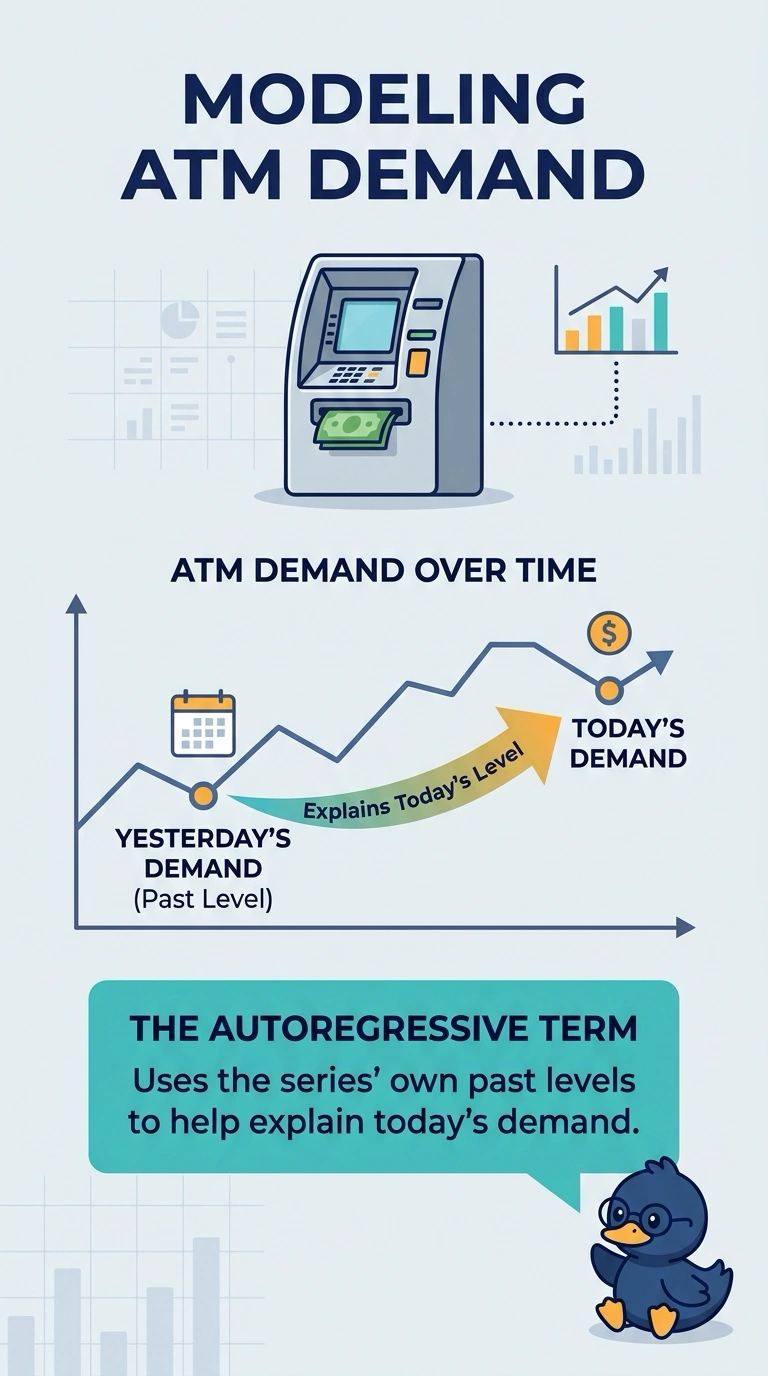
Guessing today's crowd from yesterday's crowd means you are using your own past levels. The coefficient on yesterday's ATM demand is an autoregressive term. The trap is calling it a moving-average term, which would multiply yesterday's surprise instead of yesterday's level.
Full Explanation
An autoregressive term predicts the series from its own earlier values. Yesterday's ATM demand is a past level of the same series, and a coefficient on that level is the autoregressive piece of the equation, not a coefficient on a residual. The level-versus-shock distinction is the whole point: that same slot in the equation is a moving-average term only when the coefficient sits on a past forecast error. A moving-average term instead multiplies past shocks, such as yesterday's forecast error, the gap between what was predicted and what occurred. The stem uses the demand level, so the moving-average description does not fit. A weekday dummy is an indicator for a calendar slot; it does not multiply yesterday's cash demand. An exogenous regressor imports another series, such as payroll dates, and the stem's term stays inside the demand series itself. Exam caveat: a larger model can contain autoregressive, moving-average, and exogenous terms together; the term that multiplies a past level is still the autoregressive one. Operational check: in the fitted equation, confirm that term multiplies a lagged cash-demand value and not a lagged residual.